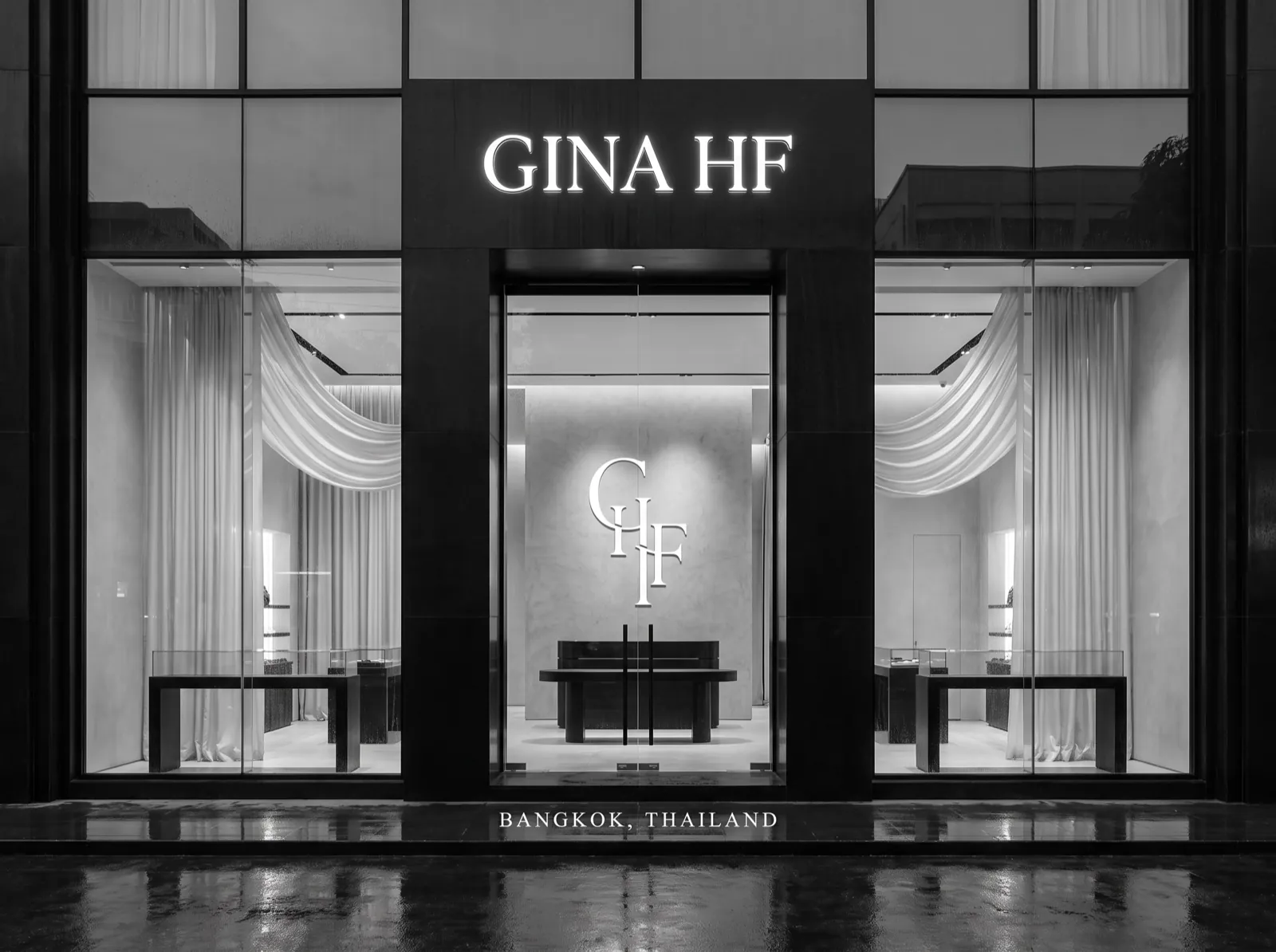
A city of silk merchants, trim suppliers and patient hands. Why a house devoted to what is worn closest to the skin makes it here, and nowhere else.
People expect a lingerie house to say Paris. It is the honest answer for the lace, and we will come to that. But the rooms where our garments are cut, sewn and fitted are in Bangkok, and this was not a compromise arrived at for cost. It was a decision about proximity — to silk, to trim, to weather, and above all to hands that already knew how to do this work before we asked them.
The city is a supply chain you can walk
Lingerie is a trim-heavy discipline. A single bra can carry eleven distinct materials: face silk, lining, power mesh, cup foam or tulle, underwire, wire casing, underband elastic, strap elastic, ring and slider, hook-and-eye tape, and thread in two weights. In most cities, sourcing those eleven means eleven suppliers, eleven minimum order quantities and six weeks of samples in the post. Here, a substantial share of them exist within an afternoon's walk of one another in the old trade quarters, and the rest arrive within days.
That proximity changes what is possible to design. When you can hold four widths of picot elastic against a cut cup at eleven in the morning and place an order at three, you iterate. You discover that the 9mm picot flattens the neckline of a plunge in a way the 12mm does not, and you find that out in a day rather than a season. Distance from your materials does not merely slow a house down — it quietly narrows what it will attempt.
Silk, close at hand
Thailand has woven silk for centuries and continues to. Being in the country means we can buy in small, specific quantities and inspect before committing: hold the piece to a window, check the weave for slubs and skipped picks, feel where the hand goes soft. We work mostly with a mid-weight charmeuse — heavy enough to fall rather than float over the hip, light enough that a bias-cut slip does not hang like a curtain. Choosing that weight is a matter of touching a dozen candidates, not reading a spec sheet. You cannot do it from a catalogue, and nobody ever has.
And the lace, which comes from elsewhere
We import our lace, and we say so plainly. The narrow, slow Leavers looms of northern France and the Chantilly tradition behind them produce a fabric no other machine has matched: a lace whose ground and pattern are made in a single pass, whose scalloped edge needs no finishing, and which is soft enough to sit directly against skin without a lining. It is expensive, it arrives on long lead times, and there is no local substitute that would not be a downgrade dressed up as a story. A house should be candid about where each thing comes from. Ours comes from two continents, and the reasons for each are specific.
“We do not source what is nearest. We source what is right, and then we build the rooms as close to it as we can.”
GINA HF — Bangkok
Heat, humidity and the discipline they impose
A humid climate is generally described as a difficulty for fine sewing, and it is one. Silk picks up moisture from the air and lengthens; tulle grows limp; a pattern piece cut at nine in the morning is not quite the same object at four in the afternoon. We answer this with dehumidified cutting rooms, with cut-and-rest intervals built into the schedule, and with the habit — universal here, unusual elsewhere — of never cutting and sewing the same piece in the same session.
What is less often said is that this climate is also a rigorous testing ground. Lingerie made and worn in heat reveals its faults quickly. A seam allowance that chafes, an elastic that loses recovery once damp, a wire casing that stiffens after washing — these are discovered in weeks here, not in the second winter. Garments designed under these conditions tend to behave impeccably in gentler ones.
The hands were already here
The decisive reason is the least romantic and the most important. Bangkok has a deep bench of makers trained in fine, close, small-scale sewing: people who have set elastic on a curve for years, who understand what stretch mesh does under the presser foot, who can coverstitch a cup seam without a ridge. Intimate construction is not a scaled-down version of dressmaking. The seams are shorter, the curves tighter, the tolerances measured in millimetres, and the fabric moves under the needle in a way woven cloth does not. Nobody arrives able to do it. They are taught, over years, and they must be taught by someone who already knows.
- Setting elastic at a consistent stretch ratio around a full curve, without a guide, and having the finished band measure within a few millimetres of the last one.
- Sewing a two-part cup so the apex seam falls exactly where the pattern intends — a seam that is one millimetre off centre reads on the body as asymmetry.
- Turning and topstitching a strap of finished width under 10mm so it neither twists nor bulks.
- Judging by feel when the machine tension is fractionally wrong for a given mesh, before the seam shows it.
A small house, deliberately
Being here also permits a scale we would not otherwise afford. We are a small number of people in a set of quiet rooms. Every piece passes through a handful of pairs of hands, all of whom can be asked a question in person. Nothing is briefed by email into a factory the house has never entered. If a cup seam is ridging, the person who sewed it and the person who drafted it stand at the same table and resolve it that morning.
So: not Paris, though the lace is French. Not a factory floor in a country we have never visited. A city where the silk is close, the trims are closer, the climate is honest about faults, and the skill was here long before we were. That is the whole of the answer.