
How a pencil line becomes a cup, a band and a strap — the mock-ups in cheap mesh, the corrections in red chalk, and why the first version is meant to be wrong.
A sketch is a wish. A toile is the first time that wish has to answer to gravity, to a living body, and to the stubborn honesty of cloth. The passage between the two is the least glamorous and most decisive stretch of the whole process — and in intimate garments it is stricter than anywhere else in fashion, because the tolerances are measured in millimetres and the judge is a woman's skin.
The sketch promises; it cannot deliver
A drawing renders a bra as two curves and a line. It says nothing about how the apex seam will sit, whether the wire will follow the root of the breast or cut across it, how much the band must be shortened relative to the underbust measurement, or where the strap must be anchored so that it neither slips off the shoulder nor bears weight it was never meant to carry. Those are questions no pencil can answer. They belong to the mock-up.
The pattern is the translation
Between drawing and toile sits the pattern, and here a two-dimensional idea becomes flat shapes that will wrap a three-dimensional and highly individual form. There are two roads to it. Flat patternmaking builds the pieces on paper from measurements and rules. Moulage pins cloth directly onto a bust form and discovers the shapes by hand. Most of our designs use both: a drape to find the idea, a flat pattern to make it repeatable and gradable.
The central manoeuvre is the same one that governs all patternmaking, only smaller and sharper. A breast is a compound curve, and no flat piece of cloth can cover a compound curve without excess somewhere. That excess is removed either as a dart or as a seam. A two-part cup is nothing more than a dart opened all the way into a seam and rotated to run vertically; a three-part cup splits the shaping again so that the vertical seam controls projection and the horizontal one controls lift. Choosing between them is not a style decision dressed as engineering. It is engineering that happens to also be visible.
“Never fall in love with a sketch. Fall in love with the third mock-up, if it deserves it — the first one exists to tell you the sketch was lying.”
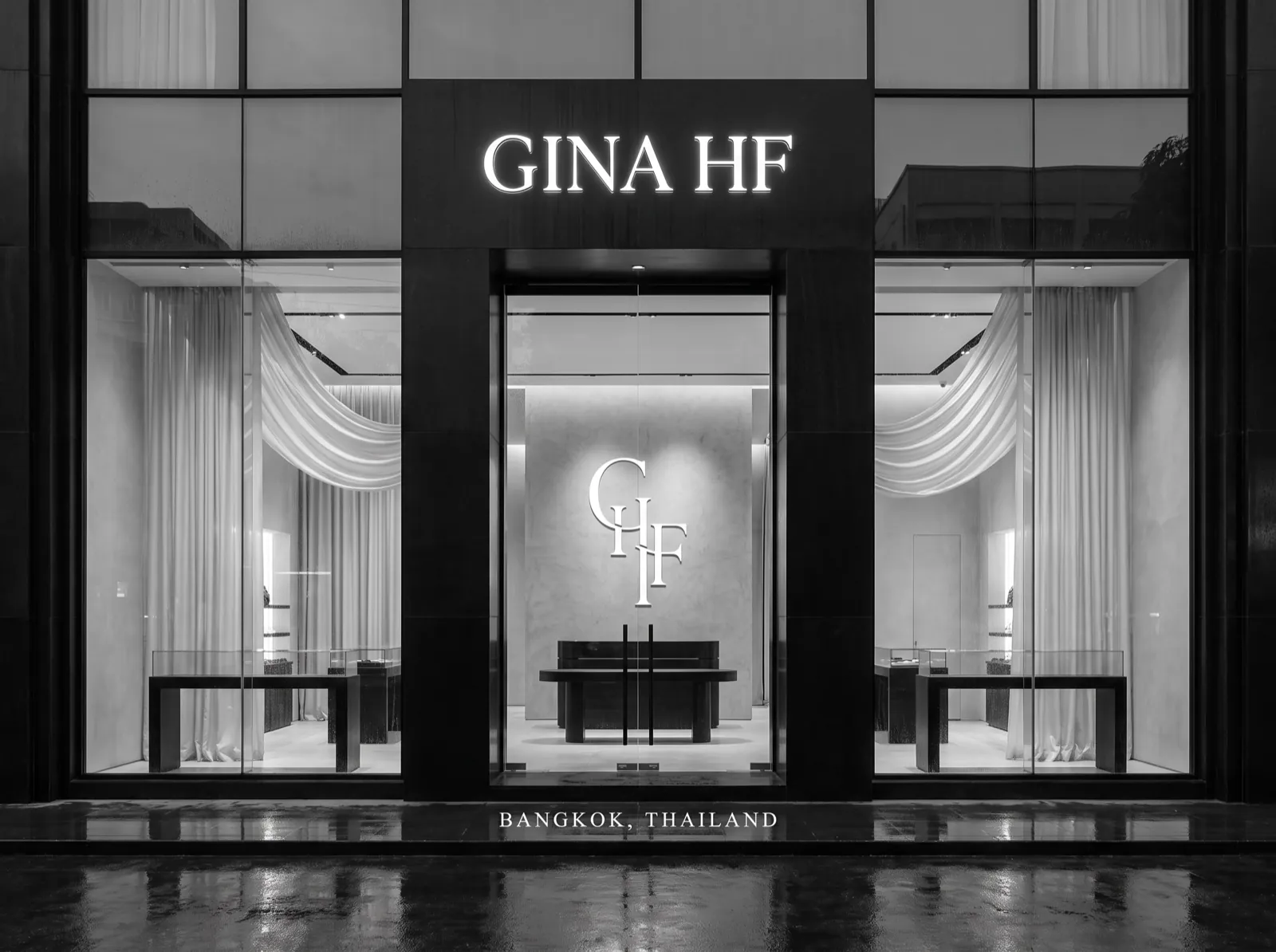
The atelier — GINA HF, Bangkok
Why the first toile is made in cheap cloth
The first mock-up is not cut in silk and Leavers lace. It is cut in inexpensive stable mesh, plain jersey and a length of ordinary tricot, chosen precisely because it does not matter. You cannot learn from a toile you are afraid to cut into. The purpose is to make the mistakes early, in material you can slash, repin, chalk over and throw away. Mocking up in the final silk would be like rehearsing in full costume on opening night: the cost of being wrong becomes too high for anyone to stay honest.
One caveat matters, and it is peculiar to stretch. A mock-up must be made in a cloth with roughly the stretch and recovery of the intended fabric, or its verdict is worthless. A cheap mesh that stretches thirty per cent more than the final power net will produce a band that fits beautifully in calico and rides up the back in production. So the fabric may be cheap, but its behaviour must be matched.
What the toile reveals that the paper hid
Put the mock-up on a body and the design begins to confess:
- Whether the wireline follows the actual root of the breast, or whether it sits on tissue and will ache by the third hour.
- Where the cup gapes at the upper edge or strains at the apex — the first says too much volume above the fullest point, the second too little projection at it.
- Whether the band stays level around the body under raised arms, or rides. A band that lifts at the back is almost always too long, not too tight; the instinct to loosen it makes the fault worse.
- How the strap angle behaves once weight is on it — an anchor point set even a centimetre too far outboard on the back will slip off the shoulder no matter how it is adjusted.
- Whether a seam allowance lies flat against skin or announces itself. This is invisible on a form and unmistakable on a person.
Correcting in red and blue
A toile is marked up like a manuscript in edit — a corrected seam in one colour, a new line in another — so the changes can be read back into the paper pattern without ambiguity six weeks later. A design may pass through four or five mock-ups before it is right, and there is no failure in that. The versions are the work. In intimates the corrections are small and consequential: three millimetres taken off the upper cup edge, the apex seam rotated by five degrees, the underband elastic ratio moved from twelve per cent to ten.
Only when the mock-up holds — level band, clean wireline, no gape, no strain, comfortable seated and standing and with the arms raised — do we cut into the silk. By then the design has stopped being a wish and become a plan. The sketch began it; the toile made it true. The most important version of any garment we make is the one no woman will ever see.