
Why the sewing tables face north, why we fit at dusk, and how a bad lamp can hide a ridged cup seam until the garment is already against a woman's skin.
Ask a maker what she needs and she will name her shears, her needles, her machine. Ask her what she would refuse to give up and the answer, after a pause, is the window. Light is the instrument no supplier sells and no inventory records, and in a house that works in silk, tulle and pale mesh it governs more than any other condition in the room.
Why the sewing tables face north
North light is indirect. It arrives without the sun in it, which means it barely shifts across the day and it throws no hard shadow. For work in ivory, porcelain and blush — the colours that dominate an intimates atelier — that is everything. Direct sun on a panel of white silk blows the surface out entirely; the eye sees a flat sheet where there is in fact a shallow gather, a faint pucker, a seam fed a fraction unevenly. Under north light the same panel shows its topography. The tables face those windows for this reason and no other, and nobody is permitted to move them.
Pale on pale is the hardest sight in the trade
Outerwear is largely dark cloth, and faults in dark cloth are read by shape. Intimate work is pale thread on pale ground, and faults there are read by shadow alone. An ivory thread on ivory silk offers no colour contrast whatsoever — the only information available is the shallow valley each stitch pulls into the surface. Remove the raking light and you have removed the only signal there was. Makers who come to lingerie from dressmaking often find their first weeks disorienting for precisely this reason: not that the sewing is harder, but that they can no longer see what they are doing in a room they had always thought bright.
“In dark cloth you look for the shape. In pale cloth you look for the shadow — and the shadow only exists if the light comes from the side.”
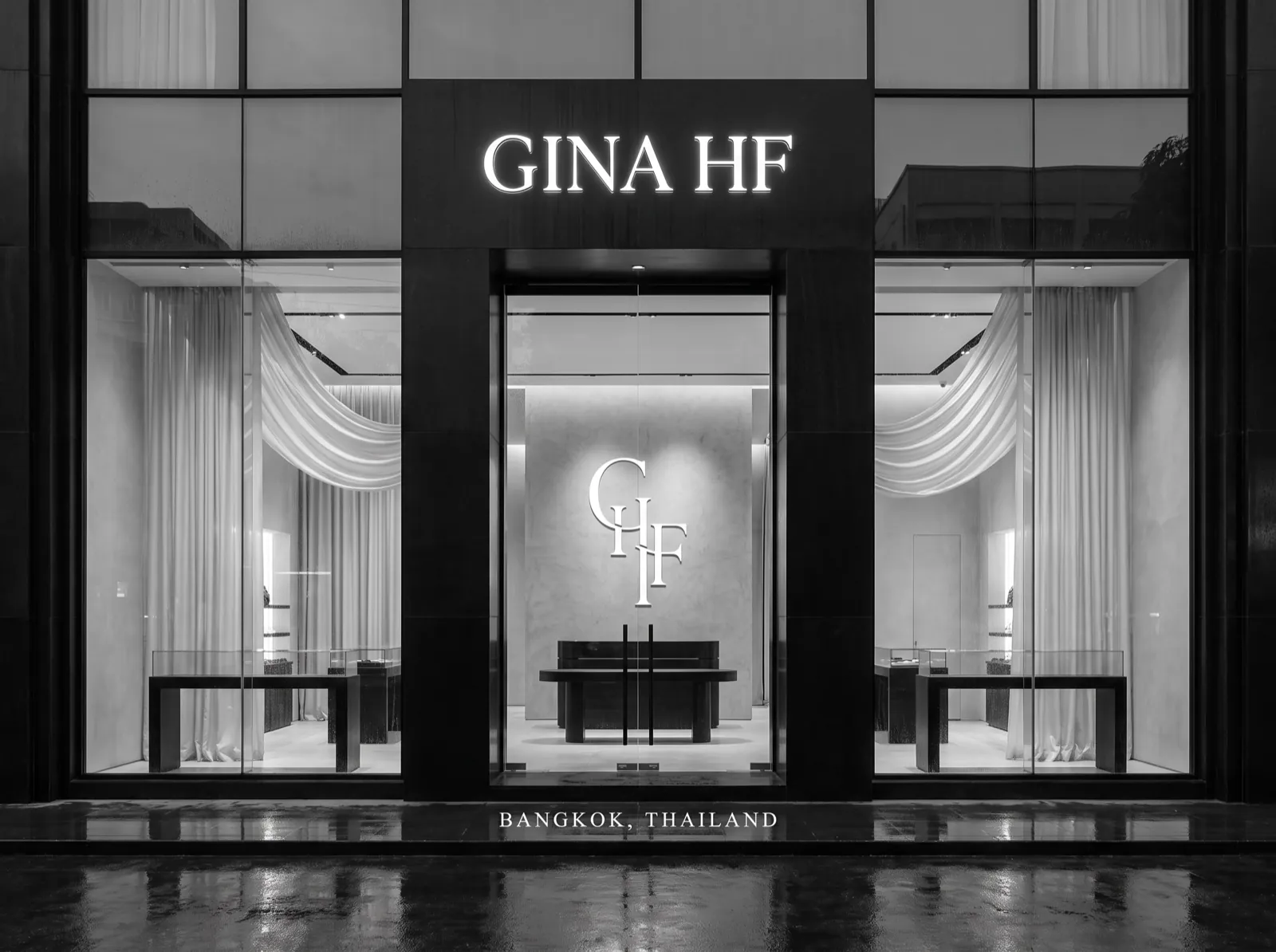
The atelier — GINA HF, Bangkok
Three kinds of light, three kinds of judgement
We use them deliberately, and for different work:
- Diffuse north daylight for cutting and general sewing. It is the least tiring, it is honest about colour, and it lets an eye work four hours without the grinding fatigue a single bright point source produces.
- Raking side light — a lamp set low and nearly parallel to the table — for inspecting a finished seam. Slide a coverstitched cup seam under raking light and every irregularity in the feed becomes a visible ripple. Under overhead light that same seam looks flawless. This is the check that catches the fault before a customer does.
- Warm, low, multi-directional light in the fitting room, because that is the light in which the garment will actually live, and because dusk is unsparing about level: band lines, hems and strap heights confess asymmetries at six o'clock that they concealed at noon.
Colour, and the lie a cheap lamp tells
Every dye lot is checked in daylight, without exception. Two rolls of the same nominal ivory can be visibly different at a window and appear identical under a cheap fluorescent tube — because a poor light source is missing whole regions of the spectrum and cannot render a difference it is not emitting. The result is a garment whose lace band and silk body are subtly mismatched: invisible in the workroom, glaring the first time it is worn near a window. Where daylight is unavailable we use full-spectrum lamps with a high colour rendering index, and we still carry the final decision to the glass.
Skin is part of the palette
Here is the difference peculiar to our discipline. A coat is judged against the world. Lingerie is judged against a woman's own skin, in her own room, in her own light. A blush that reads beautifully on the cutting table can vanish against one complexion and glow against another. So the fitting room is not lit like the workroom. It is lit warmly, from more than one direction, at roughly the level of a lamp beside a bed — because that is the honest test. A colour that only works under studio light is a colour that only works in a photograph.
The fatigue you can count in unpicked seams
There is a practical argument beneath the aesthetic one. Close handwork in pale thread demands sustained focus, and the eye tires in proportion to how hard it must strain. In poor light the error rate climbs through the afternoon — not gradually, but in a step, usually around the fourth hour. We schedule against it: the closest work in the best light, the mechanical work later, and the day ends when the light does rather than when the clock says so. On paper it costs hours. In practice it saves them, in seams that never need unpicking — and in stretch mesh, an unpicked seam is a scar the fabric keeps.
The discipline of waiting
The hardest habit to teach is knowing when not to work. There are decisions we will not take under electric light however pressing the week: the final placement of a lace scallop over a cup, the approval of a hem, the sign-off on a dye lot. To settle any of those at nine in the evening is to gamble on a verdict the morning may overturn, and the morning usually does. So we wait. The light comes back, as it always does, and the work it judges is better for the patience.
None of this appears on a label. No one will ever know which way the windows faced. But she will know, without being able to say why, that the seam under her hand lies perfectly flat — and that flatness was decided by the light long before it was decided by the needle.