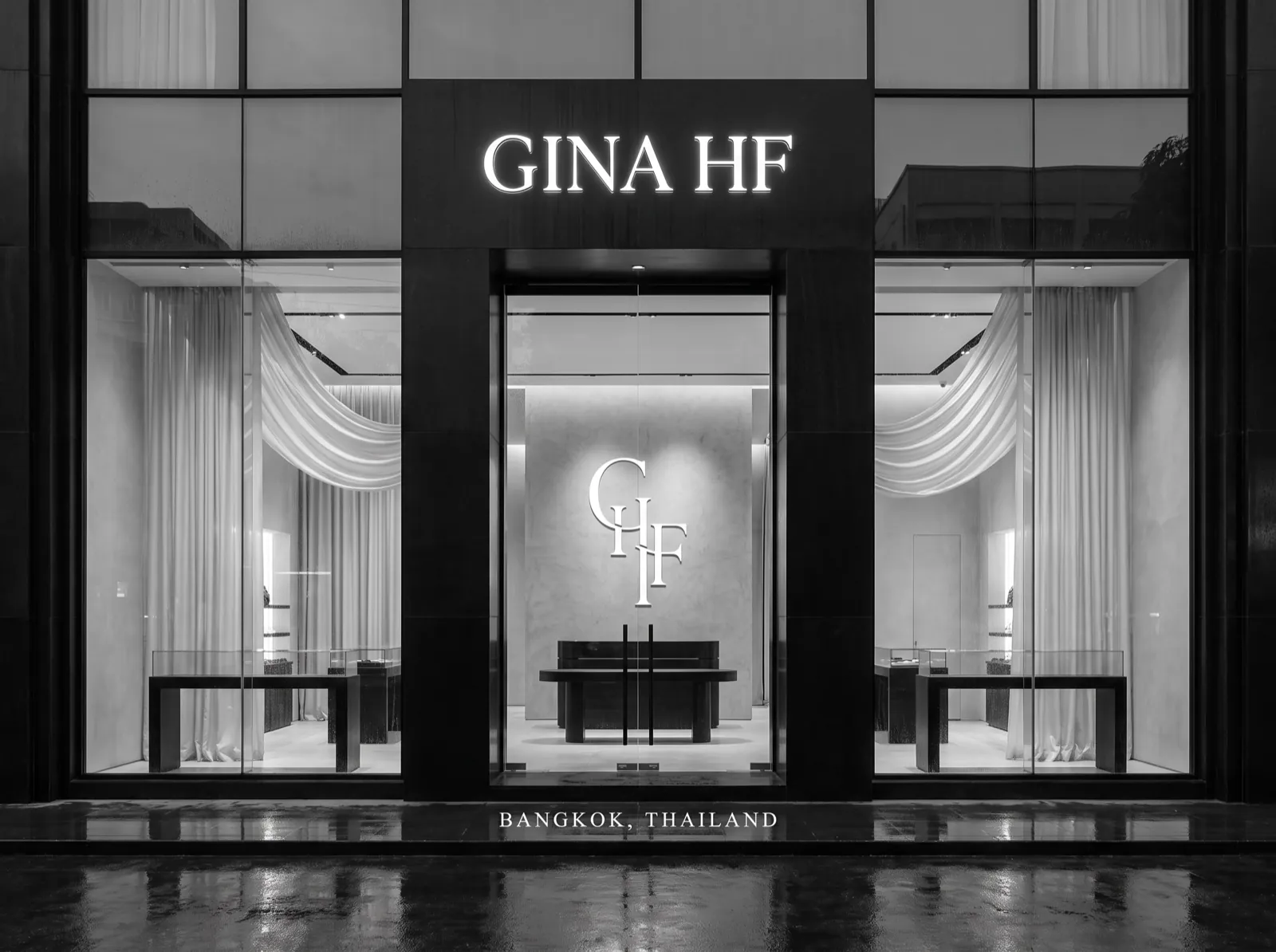
An ordinary working day inside the GINA HF atelier in Bangkok — cutting silk at dawn, the elastic hours, the fitting held in the last honest light.
An atelier that makes lingerie does not keep office hours. It keeps the hours of the cloth — of silk relaxing on the bias, of elastic settling after it has been stretched and released, of the late afternoon when the light finally falls at the angle that tells the truth about a seam. This is an ordinary day in our rooms in Bangkok, written down not because it was unusual, but precisely because it was not.
Seven o'clock: the room wakes before the work
The first task of the day belongs to nobody's hands. We open the shutters on the east side and let the room breathe. Silk charmeuse that has rested overnight on the cutting table has settled into the wood and given up the tension it carried off the bolt. The air, still cool, holds none of the humidity that by three o'clock will make a metre of tulle cling to the forearm and lie about its own grain. We sweep. We wind bobbins. We change needles — a fresh size 60 microtex on the flat machine, because a needle blunted by yesterday's mesh will punch rather than pierce, and a punched hole in silk never closes. For twenty minutes the atelier is only the sound of small preparations, and that quiet is part of the craft, not a prelude to it.
Eight to eleven: the cutting hours
Cutting happens early and is never rushed, because a length of cloth is cut only once. Two reasons govern the hour: the cutter's eye is freshest, and the fabric, before the heat rises, lies flattest. A bias-cut slip in silk will take the better part of three hours to lay, to true the grain, to chalk and only then to open the shears. Bias is unforgiving of hurry. Pull the layer half a centimetre out of true and the finished slip will spiral on the body — the side seam will migrate toward the front of the thigh by evening and no amount of pressing will call it back. So we lay single-ply, we weight rather than pin through the body of the cloth, and we let the piece rest on the table for an hour after cutting so the edges can relax before anything is sewn.
Lace is cut to a different logic entirely. A Leavers or Chantilly panel is not cut to a pattern shape so much as to its own design — we place the scallop where the body wants an edge, and we cut around the motif rather than through it, which means the pattern piece moves across the yardage until the flower falls in the right place over the cup. This is why lace consumption is never a simple multiplication of pattern area. Two identical bras can differ by a third in lace used, depending on where the repeat happens to fall.
“You are not cutting fabric. You are spending it. There is no more of this exact piece anywhere in the world.”
The atelier — GINA HF, Bangkok
The midday pause
Between noon and one the atelier eats together at the long table where toiles are sometimes pinned. It is not sentiment. A maker who has been threading a size 9 needle through tulle for four hours needs to look at something far away, eat something warm, and let the eye lengthen its focus. The afternoon work depends on it — close handwork done by a tired eye is not slower, it is wrong.
One to five: the elastic hours
The afternoon belongs to construction, in the order the garment demands. Elastics first, because they set the geometry that everything else must live inside:
- The underband, applied at a measured negative ease — typically the elastic is cut some ten to fifteen per cent shorter than the fabric edge it will carry, and stretched to fit as it is stitched. That ratio is the single most consequential number in a bra. Too slack and the band rides up the back; too tight and it burns a line under the ribs by the third hour of wear.
- The neckline and leg elastics of a brief, applied with a different ratio again, because the leg of a brief must recover against movement while the neckline need only hold its place.
- Cup seams sewn flat, then topstitched down so no ridge stands between the body and the outer layer. A flat-felled or coverstitched cup seam takes roughly four times as long as a plain seam pressed open, and it is the difference between a garment you forget you are wearing and one you take off at nine o'clock.
- Straps set last, once the band and cups exist as one object, because a strap's angle can only be judged against a finished frame.
Across these hours the room speaks very little. There is a particular quality to the quiet of competent hands — unhurried, certain, with the small percussion of a machine run at half speed marking the time. We run the flat machine slowly on purpose. Speed is the enemy of a straight line in stretch mesh, and mesh does not forgive an unpicked seam: every stitch leaves a mark.
Five o'clock: the light returns the verdict
Fittings are held at the end of the day on purpose. By five the hard glare has softened to a long, raking, honest light that shows every seam for what it is. A cup seam that read as smooth at noon reveals a shallow ripple at dusk, where the mesh was fed a fraction faster than the silk beneath it. A hem that read as level shows itself proud on one side. We trust this light above any measurement, and we fit standing, seated, and with the arms raised, because a garment worn against the skin is judged by an entire evening and not by a mirror.
Then the shutters close on the west side, needles go back into the cushion point-inward, and the cut pieces are laid to rest under cotton until morning. Nothing is left half-cut. Nothing is hurried to finish before dark. The work will be here tomorrow, and so, with discipline and a little luck, will the light.