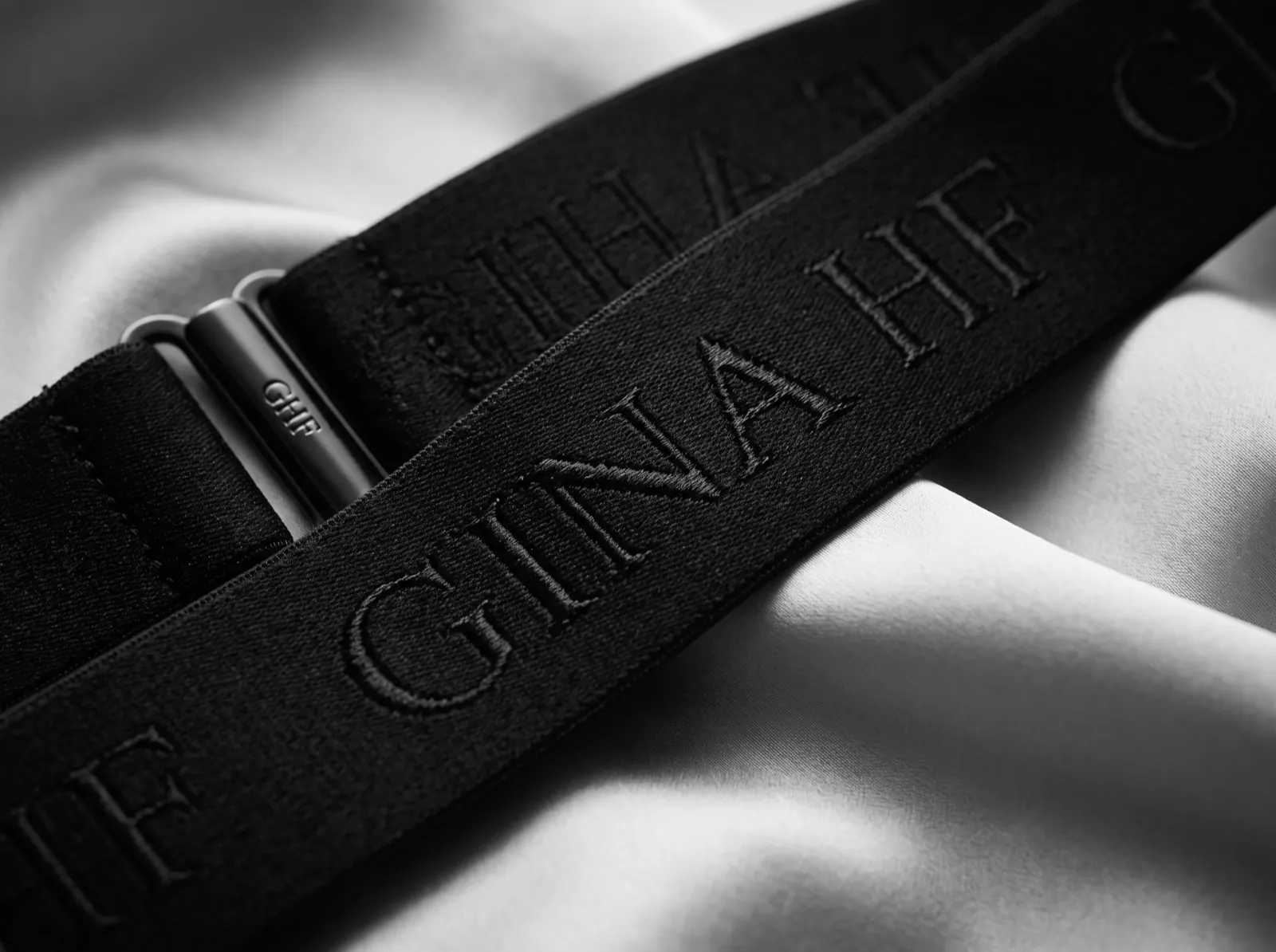

A strap that digs is telling you something, and it is almost never about the strap. How weight is distributed in a bra, where the anchor points belong, and how to read the marks on your shoulders.
If you remember one thing about buying a bra, let it be this: buy for the band. The strap is the part every woman touches, adjusts and blames, and it is the part that should be doing the least. A strap is a reminder, not a support. When it starts to support, it leaves a mark, and that mark is a message about a failure somewhere else entirely.
The arithmetic of load
In a correctly fitted bra, the band carries the great majority of the weight — commonly put at eighty to ninety per cent — and the straps carry the remainder. The band achieves this by being a closed ring of controlled tension around the ribcage, anchored below the load and pushing up against it, the way a bracket carries a shelf. The straps merely hold the upper cup in contact with the body so it does not fall away when you lean. Once the band loosens or rides up, that ratio inverts fast, and the entire weight of the garment plus everything it contains is transferred to two narrow strips resting on the trapezius muscle.
This is why a woman who shortens her straps to get more lift is making the problem worse by exactly the amount she tightens. She is not adding support; she is pulling the back of the band upward, reducing the band's ability to hold, and increasing the share of load the straps must carry. The relief is immediate and the discomfort arrives by mid-afternoon.
Reading the trouble signs
The shoulders keep an accurate record. Learn to read it before your next fitting:
- A red groove that is still visible an hour after undressing — the band has stopped working and the straps are carrying the garment.
- A strap that slides off repeatedly — the straps are set too far apart for your shoulder width, or the band is too large and the whole garment is travelling.
- Straps at the correct length but a band that lifts at the back when you raise your arms — the band is too loose; go down a size and up a cup.
- Cutting at the front of the shoulder only — the strap attachment on the cup is placed too far toward the centre for your frame.
- A gap of more than two fingers under a strap while the garment still feels supportive — the straps could be loosened and the band is doing its job properly.
“A strap should be able to be lifted an inch from the shoulder without the garment moving at all. Anything else is a band that has given up.”
The fitting room, Bangkok
Placement, and why women differ
Shoulders are not standard. Their width varies, their slope varies, and one is usually slightly lower than the other — most often on the side of the dominant hand. A strap is attached at two points, at the cup and at the wing, and the horizontal distance between those points relative to the body decides whether the strap sits in the natural hollow or slides toward the arm. Narrow, sloped shoulders need attachments set closer together; broad or square shoulders need them set wider, or the strap will cut into the side of the neck. On a made-to-measure piece we move those attachment points on the pattern, which is a two-minute correction that no amount of adjuster hardware can imitate.
On width, honestly
A wider strap distributes pressure over more skin and is genuinely kinder to a shoulder carrying real weight. But a wide strap is a compensation, not a solution — it makes a badly balanced garment tolerable rather than correct. We use narrow silk-covered straps on soft, light pieces without hesitation, and wider, padded ones where the load is substantial, and in both cases the decision follows the band, never precedes it. If a design requires a very wide strap to be bearable, the band was wrong and we begin again.
What to do in a fitting room
Invert the order of your attention. Ignore the neckline, ignore the lace, ignore what the straps look like from the front. Fasten the garment on the loosest hook — the tighter ones exist for later, when the elastic has aged — and try to pull the band away from your back. If it lifts more than a few centimetres, the piece is wrong regardless of how well the cups appear to fit. Then slide a finger under each strap and lift. If the whole garment rises with it, the band is not carrying you, and by evening your shoulders will be doing work no one asked them to do.