Everything that gives a piece of lingerie its shape is invisible from the outside. A field guide to the structural materials — what each one does, where it belongs, and how it fails.
Turn a well-made bra inside out and you are looking at a small piece of engineering. There is a metal arc in a fabric tunnel, a stiffened panel at the side, a firm net that stretches in one direction and refuses in the other, and a layer of tulle you can barely see, doing more than any of them. None of this is visible when the garment is worn. All of it decides whether the garment works.
The underwire
A wire is a defining edge, not a lifting device. Its job is to sit precisely in the crease where breast tissue attaches to the ribcage and to give the cup a rigid boundary to be built from. Wires are specified by three things and only three: width at the opening, height of the arms, and the gauge of the metal. Width must match the root of the individual body; too narrow and it stands on tissue, too wide and it wanders into the underarm. Height decides how much of the side is contained. Gauge decides how much the wire will flex during the day and how quickly it will fatigue — a heavier gauge is more supportive and less forgiving, and both of those are sometimes what a woman wants.
A wire should never touch skin or thread. It travels in a channel: a narrow tunnel of soft twill tape stitched along the cradle seam, closed at both ends so the wire cannot migrate and cannot work its way out through the fabric. When you read about a wire poking through, you are reading about a channel that was closed by machine at speed rather than secured by hand.
Boning, which is not the same thing
Boning is vertical, and it lives at the side seams of a longline, a bustier or a corsetted slip. Its job is to stop a panel from collapsing on itself when the body bends. Spiral steel bends in every direction and is what we use anywhere the garment must follow a curve; flat steel bends in one plane and belongs at a straight centre-back opening; synthetic boning is lighter and quieter and appropriate in soft pieces where the load is modest. All three must be tipped and cased. An untipped bone will find its way out of the casing eventually, and it will do so on an evening when it is least welcome.
“Structure is a promise made in materials nobody will ever see. That is precisely why it is where a house's honesty is tested.”
The atelier
Power mesh and the art of one-way stretch
Power mesh is a firm knitted net engineered to stretch generously in one direction and barely at all in the other. Laid into the wings of a bra or the side panels of a slip with its stable axis running vertically, it lets the garment give around the ribs as the woman breathes while refusing to let anything ride up. Rotate that same piece of mesh ninety degrees during cutting and you have produced a garment that does exactly the opposite of what it was designed to do — which is one of the reasons cutting is not the unskilled part of this work.
- Firm tulle interlining — invisible memory inside a seamed cup; keeps the drafted curve from relaxing over a season.
- Power mesh — one-way stretch in the wings and side panels; the reason a band stays level.
- Cradle fabric — a stable, non-stretch woven; the frame everything above is built onto.
- Wire channel tape — soft, narrow, hand-closed at the ends.
- Bone casing — a channel of its own, never the seam allowance, and always tipped at both ends.
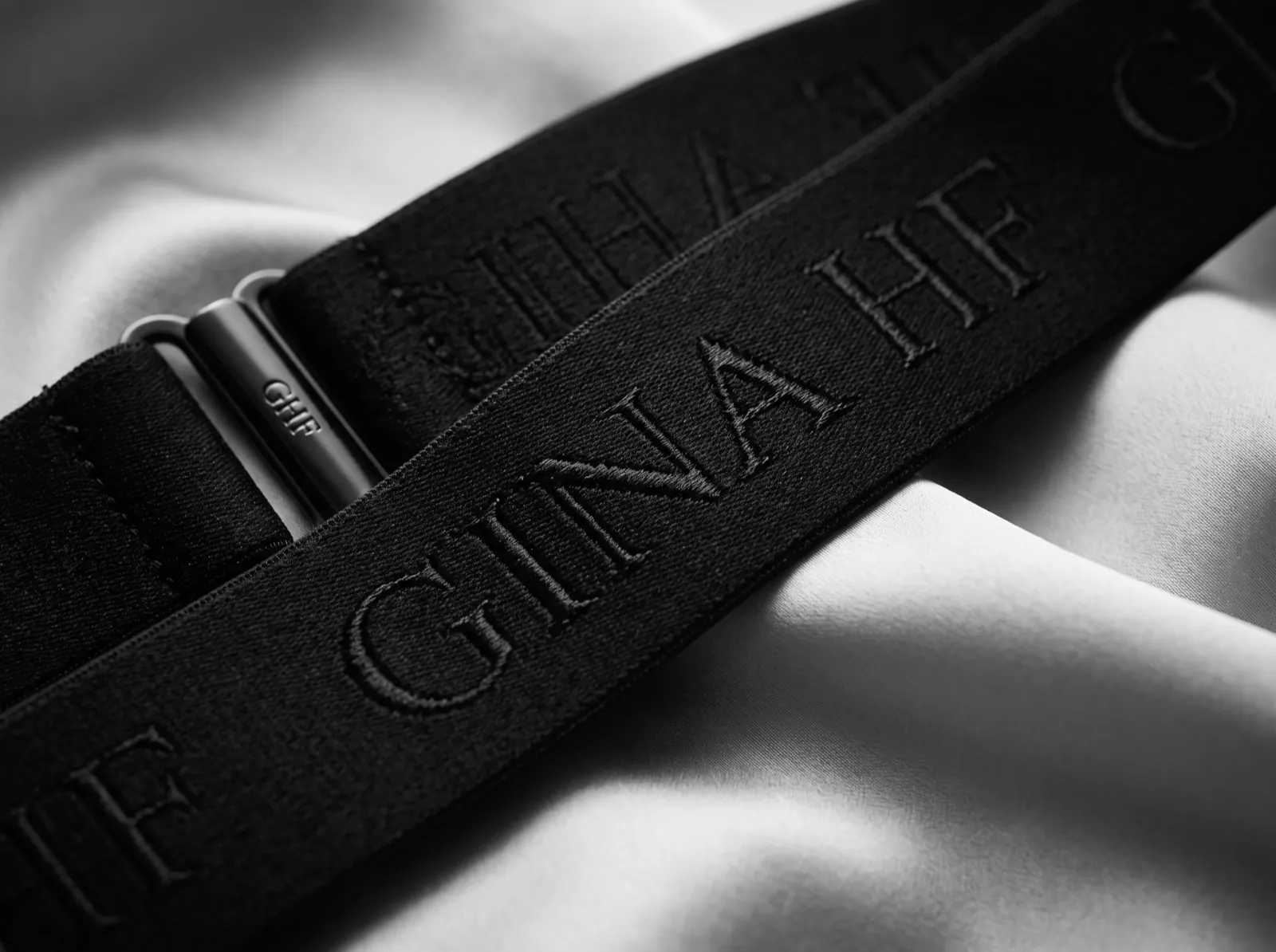
- Strap elastic — chosen for limited elongation, because a strap that stretches all day is a strap that has stopped adjusting anything.
How a skeleton fails
Structural materials rarely tear; they tire. Elastic loses recovery, mesh loses its refusal, wires take a permanent set and stop matching the root they were fitted to. The tell is that a garment which fitted beautifully now needs a tighter hook to feel the same — the fabric is asking you for help it should not need. At that point the piece is not broken, it is finished, and understanding the difference will save you from tightening your way through a year of gradually worsening comfort.
What we choose, and why
We build the lightest skeleton that will do the work and not one component more. A soft-cup piece in silk and Chantilly may have no wire at all, its shape coming entirely from a drafted seam and a whisper of tulle. A longline may carry six bones and a fully mesh-backed wing. The decision is never about how supportive a garment can be made to look on a hanger. It is about what a specific body needs in order to stop noticing it is wearing anything.