A bra is the most engineered garment a woman owns. A guided tour of its parts — cradle, wing, band, bridge, cup seams — and what each one is quietly doing against your body.
There are perhaps twenty-eight separate components in a well-made bra, and a woman wearing one is asked to notice none of them. That is the whole ambition of the object: to carry weight, hold a shape, survive a laundering cycle several hundred times, and disappear. No other garment in a wardrobe works this hard while asking so little attention. If you learn to read it — to turn it inside out and see what each piece is doing — you will never again buy one by the front alone.
The band does almost all the work
Begin where nobody looks. Between eighty and ninety per cent of the support in a bra comes from the band, not the straps. The band is a closed ring of elastic tension around the ribcage, and it works the way a shelf bracket works: by anchoring low and pushing up. This is why a band that rides up at the back is not a cosmetic annoyance but a structural failure — the shelf has come off the wall, and the straps are now doing a job they were never engineered for, which they will report to you as a groove in the shoulder by three in the afternoon.
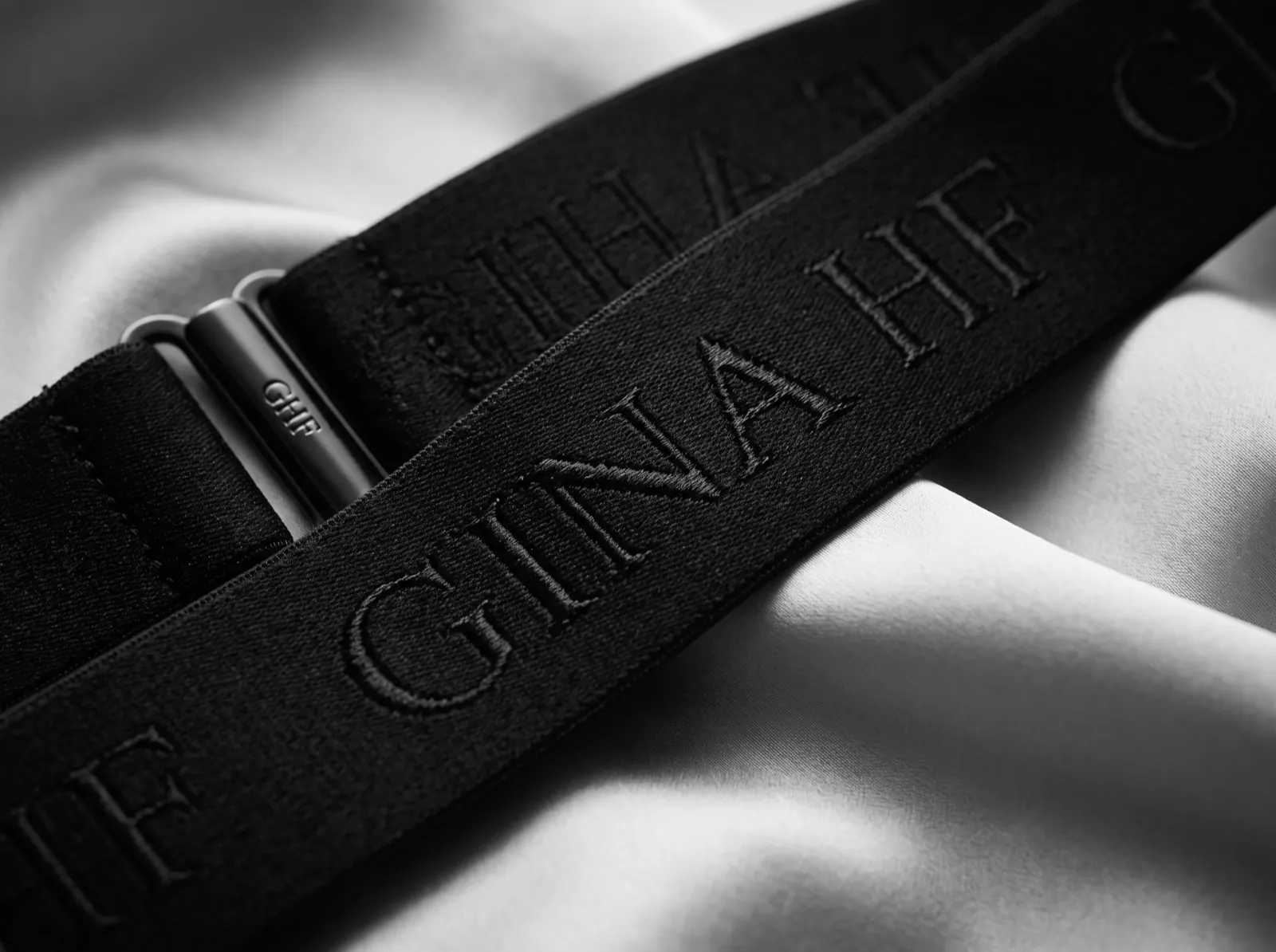
A band is not one material. In our workroom it is built from a firm elastic with limited stretch along its length, faced so no raw edge touches skin, and reinforced where the hooks sit so the tension does not concentrate on four small bars of metal. The stretch is deliberately directional: it gives around the ribs as you breathe and refuses to give downward, which is what keeps it level.
The cradle and the wings
The cradle is the frame the cups sit in — the horseshoe of fabric that runs under and around them. It is usually cut from a stable, non-stretch material precisely because everything above it is asked to move. The wings are the panels running from the cradle around to the hooks, and their height is one of the least discussed decisions in the trade. A tall wing distributes pressure over more skin and stops soft tissue from spilling at the underarm; a short, low-cut wing looks cleaner under a fitted dress and demands a better match between body and pattern.
“The band holds. The cup shapes. The strap only reminds. Confuse those roles and the garment will fight the woman all day.”
The atelier
The bridge, and what it tells you
The bridge — the small panel between the two cups, sometimes called the gore — is a diagnostic instrument disguised as a detail. On a well-fitted bra it lies flat against the sternum, in contact with the bone. If it floats away from the body, the cup volume is too small and is pulling the bridge forward. If it is pressing hard enough to leave a red mark, the wire is too narrow for the root of the breast. Nothing else in the garment gives you such an honest reading so quickly, which is why a fitter's first glance in the mirror goes there rather than to the neckline.
The cup and its seams
A cup is a piece of two-dimensional cloth persuaded into a three-dimensional volume, and there are only two honest ways to do it: seam it or mould it. A seamed cup — most often three panels, sometimes four — builds shape from geometry. The horizontal seam sets projection and lift; the vertical seam controls where the fullness sits and therefore how forward or how centred the shape reads. Move that seam a few millimetres and the whole silhouette changes. A moulded cup takes a flat circle of fabric and heat-forms it over a shaped tool, giving a seamless outer line at the cost of some of that adjustability.
- Upper cup — usually the softest, sometimes stretch lace or sheer tulle, because this is where the body changes most across a month.
- Lower cups — stable and non-stretch; these carry the weight and set the projection.
- Wire channel — a narrow tunnel of soft tape sewn along the cradle seam so the wire never meets skin or thread.
- Strap attachment — reinforced at both ends, since this is the second-highest stress point in the garment after the hooks.
- Elastic finishing — a separate, softer elastic at the neckline and underarm, chosen for comfort rather than tension.
The wire, correctly understood
An underwire is not there to lift. It is there to define the boundary — to sit in the crease where breast tissue ends and the ribcage begins, and to give the cup a fixed edge to build from. A wire that fits follows that root exactly, ending flat against the ribs under the arm without stabbing. Most complaints about wires are not complaints about wires at all; they are complaints about a wire of the wrong width being asked to sit somewhere it does not belong.
What all this costs in hours
A bra of this construction passes through many more operations than a dress of the same weight. Each seam is stitched, then finished so no seam allowance abrades the skin. Each elastic is applied in two passes — attached, then turned and topstitched — because a single pass leaves an edge that will curl within a season. The wire channel is closed by hand at the ends so the wire cannot travel. These are not luxuries. They are the difference between a garment that is comfortable on the first evening and one that is still comfortable in its third year.
How to look, from now on
Turn the piece inside out before you judge it. Look for a wire channel that is soft to the finger, elastics applied in two rows rather than one, a cradle that holds its shape when you flex it, and clean, flat seam finishes everywhere the garment will touch you. The front of a bra is a photograph. The inside is the truth, and it will tell you in ten seconds what a year of wearing would tell you slowly.