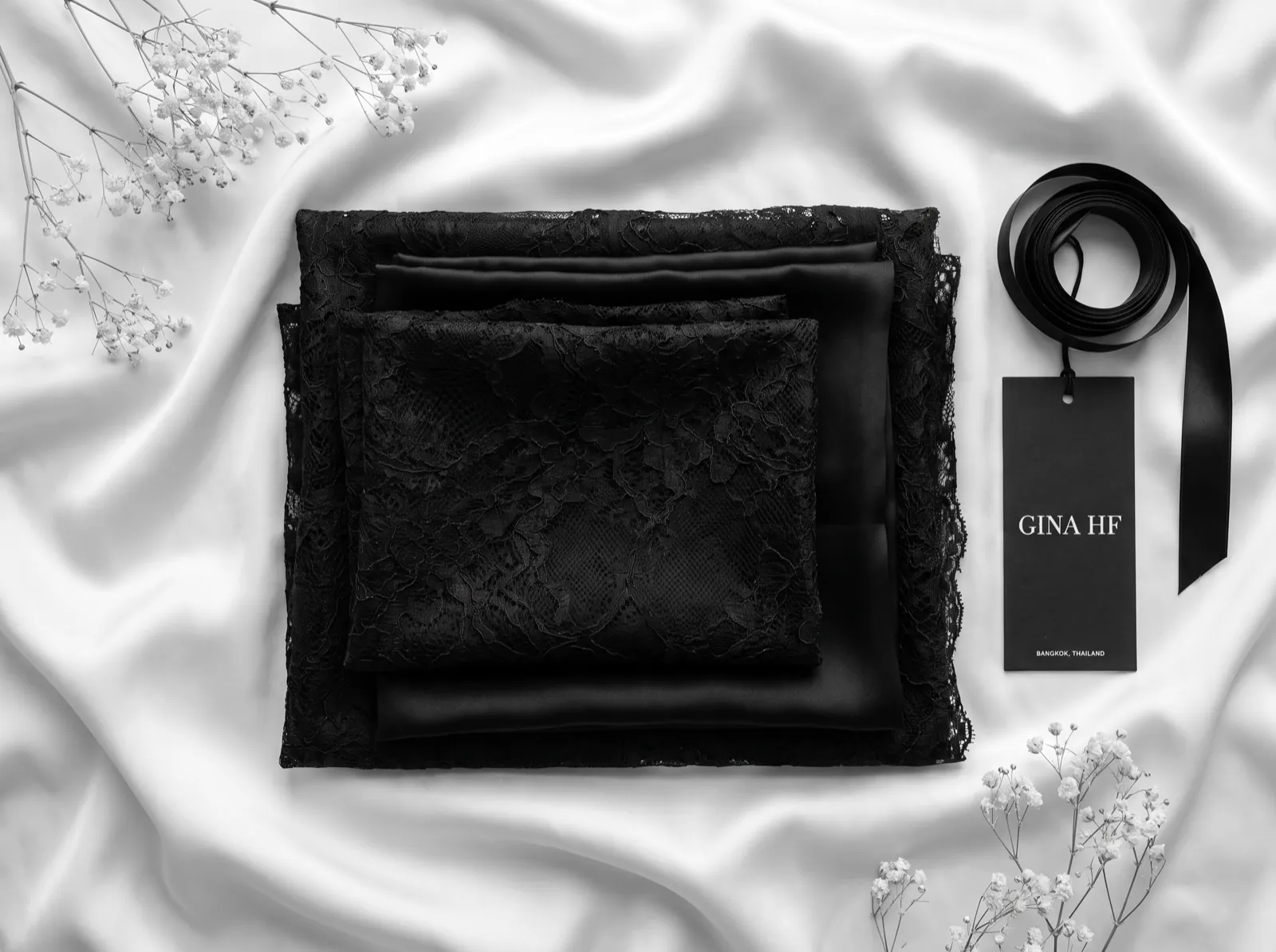

An intimate atelier is divided in two. One bench works in silk that must fall; the other builds structure that must hold. They are different crafts entirely.
A couture house has always been divided into two ateliers: the flou, which works in soft fabric that must fall, and the tailleur, which builds structure that must hold. The division is not administrative. The two are genuinely different crafts, learned differently, requiring different hands, and a maker who is exceptional at one is very often mediocre at the other.
An intimate atelier inherits the same division exactly, and in our case the two benches sit on opposite sides of the same room. The soft bench makes slips, camisoles, bias-cut chemises, French knickers, robes. The structured bench makes cups, cradles, bands, corselettes — anything that has to carry load.
The soft bench: working with gravity
The soft bench does not impose a shape. It selects a cloth, cuts it in a direction, and lets gravity produce the form. Its central technique is the bias — laying the pattern at forty-five degrees to warp and weft so the woven cloth gains a diagonal elasticity and will elongate and narrow under its own weight rather than hanging across the body in fixed folds.
Everything about this bench is slower than it looks, because bias cloth will not stay still. It must be cut singly, never folded, on a full-width table, weighted rather than pinned along the cut line. Once cut, the pieces are hung for at least twenty-four hours so the fabric can settle into its own length before any seam is sewn. Skip the hanging and the piece will drop unevenly within a fortnight of wear, and the hem will announce it. Sewing bias to bias requires the machine tension eased and the cloth fed without stretching — pull it even slightly and the seam ripples permanently.
The soft bench's finishing vocabulary is inherited directly from the lingère: French seams, rolled hems worked by hand, lace inserted rather than applied on top. The test of the work is whether the inside is as clean as the outside, because on this bench the inside is against skin all day.
The structured bench: working against gravity
The structured bench does the opposite job. Here the cloth is chosen for the smallest possible stretch — coutil, stable satin, duplex — and the shape is built rather than allowed. Its central technique is the shaped seam: a cup is made by joining two or three flat pieces whose curved edges, when sewn together, force a three-dimensional volume that neither piece possessed.
Precision here is on a different order of magnitude. A cup seam is short — often under ten centimetres — and steeply curved, and a drift of one millimetre along it moves the apex of the finished cup by considerably more. The two edges being joined are usually different lengths by design, so that one must be eased into the other, distributing a small excess evenly to create fullness. Easing is a hand skill; there is no machine setting for it. And the direction a cup seam is pressed changes the garment: pressed open and topstitched flat, it leaves no internal ridge against tissue; pressed to one side, it is faster and it can be felt for the rest of the day.
- Soft bench: bias cutting, single-layer, weighted, hung 24 hours before sewing so the cloth settles.
- Soft bench finishing: French seams, hand-rolled hems, lace inserted rather than laid on top.
- Structured bench: low-stretch coutil and duplex; shape built from curved seams, never draped.
- Easing — distributing a deliberate excess along a curve by hand — is the defining skill of the structured bench.
- Cup seams pressed open and topstitched, never pressed to one side, so nothing ridges against tissue.
Where the two benches must meet
Most interesting pieces need both, and the join between them is the hardest problem in the atelier. A silk chemise with an integrated shelf bust; a bias slip with a structured cradle beneath; a corselette faced in Chantilly. In each case a stable structural element has to be attached to a cloth that stretches diagonally, and the two will fight.
The rule we work to is that the structural layer must be complete and self-supporting before the soft layer touches it. The cradle is built, boned and finished as an independent object; only then is the bias silk attached to it, and attached only along stable lines — never across the bias, where the silk would be held rigid at one point and free at another, producing a permanent drag line. Get this wrong and you can see it from across a room: the silk pulls diagonally from the cup, and no amount of pressing will remove it.
Why we keep them separate
It would be more efficient to have every maker do everything, and we have tried. It does not work. The hands are trained in opposite directions. A soft-bench maker learns to let cloth go, to sew with almost no tension, to trust that a fabric hung properly will find its own line. A structured-bench maker learns to control absolutely, to match a curve to the millimetre, to ease a specific excess into a specific centimetre of seam. Asking one to do the other's work produces a slip that is stiff or a cup that is a millimetre out, and a millimetre out is a cup that does not fit.
“One bench asks the cloth what it wants to do. The other tells it. Both are right, and neither can be taught the other's habit in an afternoon.”
The atelier, Bangkok
So the division survives, as it has for a century and a half, for the same reason it was invented: because the two problems are genuinely different, and because a house that respects the difference makes better garments than one that finds it inconvenient.