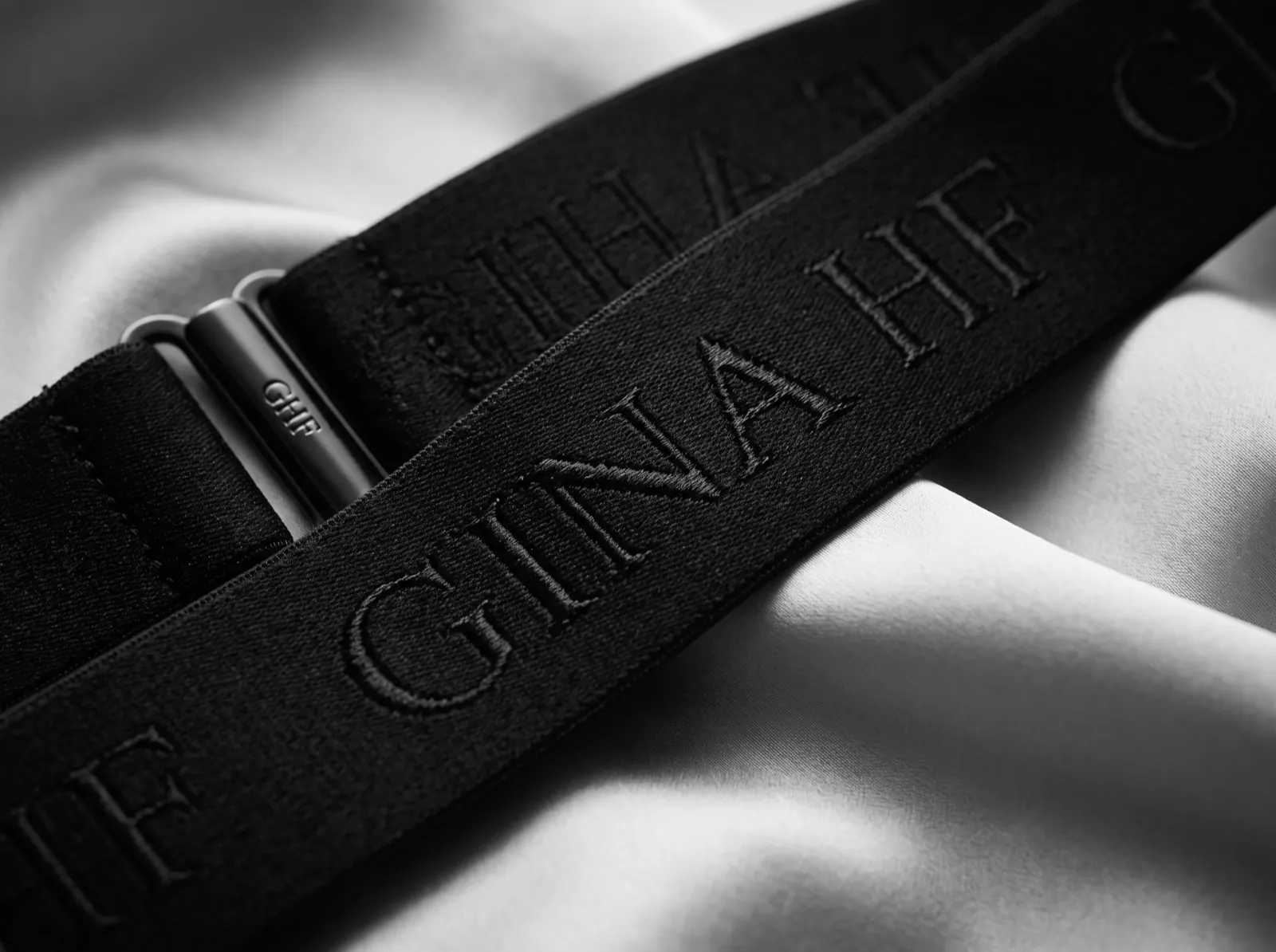
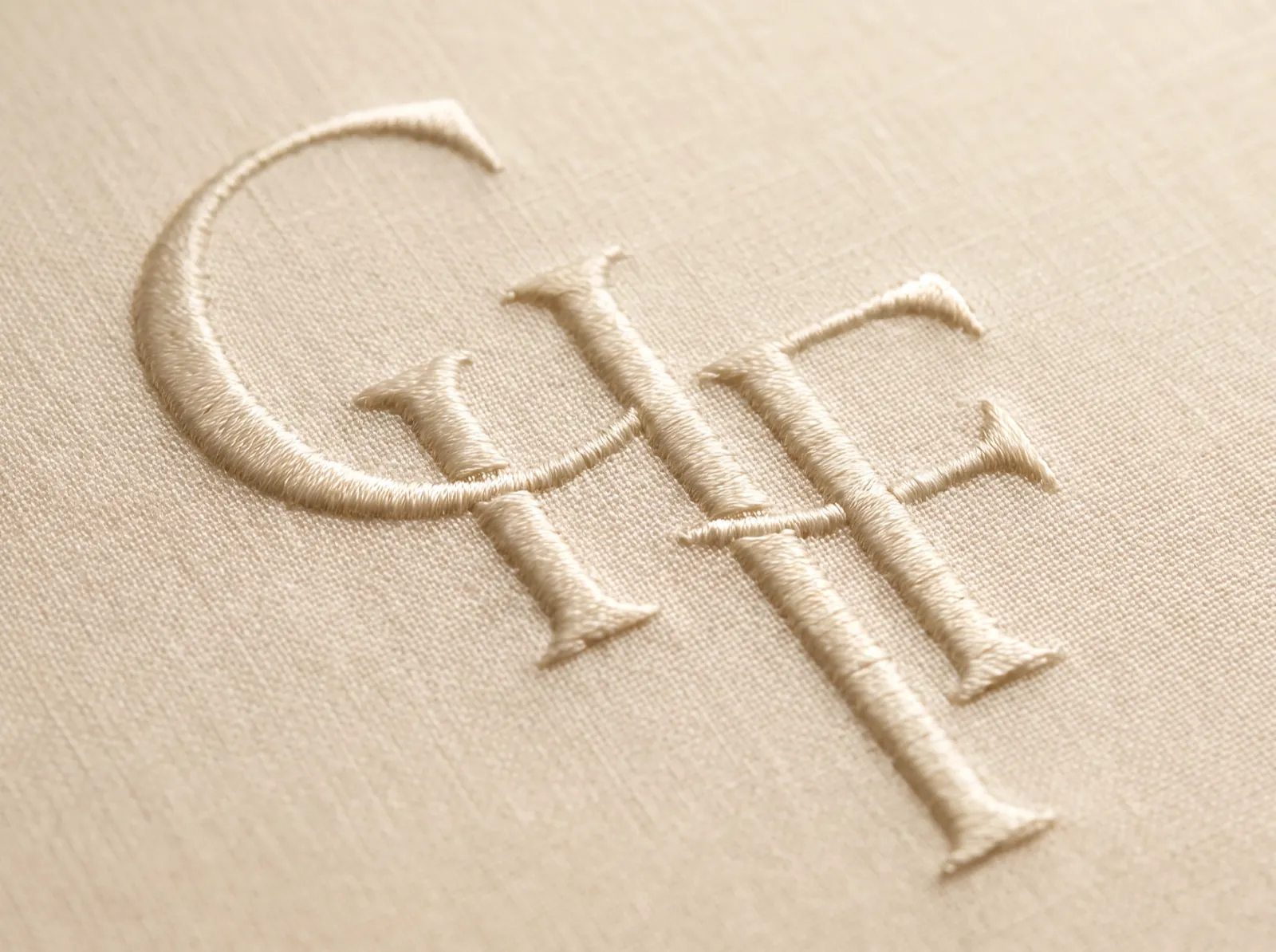
Embroidering a garment that must weigh nothing and touch skin all day. On Chantilly appliqué, the tambour hook, and why the back of the work matters most.
Embroidery on an evening gown has one constraint: it must be beautiful. Embroidery on lingerie has three. It must be beautiful, it must weigh almost nothing, and its reverse must be smooth enough to sit against skin for fourteen hours. The third constraint eliminates most of the techniques the first would suggest, and it is the reason hand-work in an intimate atelier looks so different from hand-work in a couture house.
The ground: tulle, and what it will bear
Almost all of this work happens on tulle — a fine hexagonal net, in our case silk or a very fine nylon, weighing a few grams per square metre. It is chosen because it is nearly invisible and because it has controlled give in every direction. It is also structurally fragile: every stitch you place is carried by individual threads a fraction of a millimetre thick, and a dense stitch will simply tear the ground open.
So the first rule of embroidering lingerie is that weight must be distributed. You cannot anchor a heavy motif at four points and expect the net to hold it; the motif must be attached continuously along its own outline so that the load is spread across hundreds of intersections. This single constraint dictates almost every technique that follows.
Chantilly appliqué, stitch by stitch
The characteristic technique of the house is Chantilly appliqué. Chantilly is a fine bobbin lace with a delicate hexagonal ground and floral motifs outlined in a slightly heavier thread called the cordonnet — that outline is what gives the lace its drawn, graphic quality. In appliqué, a motif is cut out of the lace along its own cordonnet, laid onto the tulle base, and stitched down with a fine invisible stitch that follows the outline exactly.
Done properly the result is remarkable: the motif appears to float on the skin with no visible means of attachment, and — crucially — no straight seam crosses the pattern. This is how a cup can be shaped and still carry an unbroken lace design. Instead of cutting the lace and joining it with a seam, the maker overlaps two pieces, matches the motifs, and stitches around the shared outline. The join disappears into the pattern. From twenty centimetres you cannot find it.
The cost is time. A single cup edge in appliquéd Chantilly is three to five hours of hand-work, and a full garment considerably more. There is no machine that does it, because the cut follows the motif rather than a line, and the motif is different everywhere.
The tambour hook
For beading and for chain-stitch work, the tool is the tambour hook — a fine hook, like a very small crochet hook, used from beneath a frame-stretched fabric. The worker sits under the work with the design facing away, catching thread from below and forming a chain stitch upward through the ground. It is disorienting to learn and extraordinarily fast once learned: a skilled tambour worker will lay in several times more stitches per hour than a needle can.
For lingerie, its virtue is specific: the chain stitch is continuous, so a line of beads is carried on a single running thread rather than on hundreds of individual anchor knots. Fewer knots means less bulk on the reverse and far less risk to the tulle. It also means that beads sit in a smooth line rather than each pulling its own small pucker.
- Tulle can carry ornament only if the load is spread along an outline, never anchored at a few points.
- Chantilly appliqué: the motif is cut along its own cordonnet and stitched down invisibly, so no seam crosses the pattern.
- Two lace pieces are overlapped and matched rather than seamed — the join vanishes into the design.
- Tambour work carries beads on one continuous chain thread: fewer knots, no bulk, no puckering.
- The reverse of the work is inspected as carefully as the face, because the reverse is what touches skin.
The back of the work
In couture embroidery the reverse is hidden by a lining and can be as untidy as the worker likes. In lingerie there is no lining. The reverse of an embroidered panel is in direct contact with skin, often over a bony area, often for a whole day. So it is inspected with the same seriousness as the face.
In practice that means no knots on the reverse — threads are started and finished by running them under existing stitches. No long floats, which catch on skin and on fingernails. No thread ends left uncut, however short. And where a bead or a heavier element is used, the reverse is faced with a small patch of soft tulle so that nothing hard ever meets the body directly. These are small disciplines and they are the difference between a beautiful piece that gets worn and a beautiful piece that lives in a drawer.
Restraint as a technical decision
The house uses far less ornament than our techniques would allow, and the reason is not taste alone. Every gram of ornament is a gram the tulle must carry and a gram the strap must lift. A heavily beaded cup pulls downward all day, changes the load on the band, and will eventually distort the very shape the structure was built to create. Ornament in lingerie is not free the way it is on an evening gown, where a bodice can simply be built stronger.
“On a gown, the embroidery only has to be looked at. Here it has to be lived against, which is a much harder brief.”
The atelier, Bangkok
So we place ornament where it does structural work as well as visual work: along a cup edge, where the appliqué stabilises the line and removes the need for a binding; at a strap junction, where a small reinforcement is needed anyway. When the decorative answer and the structural answer are the same answer, the piece is right. When they are not, we leave the ornament out and let the cloth do the work.