The piece nobody sees is the final proof that you do not dress to be seen. A close reading of the signals — the sewn label, the selvedge edge, the hand-finished cup.
Quiet luxury has been discussed almost exclusively in terms of outerwear, which is a small absurdity, because outerwear is precisely the thing other people see. A coat without a logo is still a coat worn in the street, still legible to anyone who knows how to read cloth, still — however discreetly — a statement made in public. If the argument is that true refinement does not perform, then the argument has to be tested somewhere no performance is possible. It is tested in the drawer. The garment nobody will ever see is the only unfalsifiable proof that you are not dressing to be seen.
This is why we think of lingerie as the strictest form of the discipline rather than the frivolous one. Everything you buy in it, you buy for a room with one person in it. There is no social return. There is only how it is made, and how it feels, and whether you were honest with yourself about the difference.
A vocabulary read at arm's length
A quiet garment still speaks; it simply lowers its voice until only close reading can hear it. The signals are all small, all tactile, and all invisible from across a room. Learn them and you can assess a piece in thirty seconds with your hands, which is more useful than any amount of brand knowledge.
- The label is woven and sewn in, not printed on the fabric. A printed label is cheaper by an order of magnitude and cracks after a dozen washes; a sewn label costs a separate operation and an operator's time, and it is still legible in year five.
- Stitch density. Count the stitches over an inch of a straight seam. Eight to ten is fast production. Twelve to fourteen is a seam intended to survive laundering under tension. The higher count runs slower, uses more thread, and does not pucker.
- The lace edge is the lace's own selvedge — the finished scallop that comes off a Leavers loom — used raw as the edge of the cup. Mechanical lace has no selvedge and must be bound or elastic-trimmed, which means an added seam sitting directly on your skin.
- The apex of the cup is finished by hand: the point where the seams converge is the hardest place on the garment to close cleanly, and a machine cannot do it without a small hard knot of thread.
- Tulle backing behind the lace where the cup carries load. Lace alone stretches on the bias; a fine tulle stay controls it without adding bulk or a visible line.
- Flatlock seams through the cup, so the seam lies level with the cloth rather than standing proud of it — the reason a good bra reads as nothing at all under a fine knit.
- Metal rings and sliders on the straps. Plastic cracks in warm water and slips under load.
- No logo. Not a small logo, not a discreet logo. None.
“A garment that must announce itself has already told you what it is worth. Read the inside seam instead.”
GINA HF — Bangkok
Why the sewn label matters more than it should
It is a tiny thing and it decides more than it ought to. A printed label costs almost nothing and requires no additional handling: the mark goes on with the ink and the garment moves down the line. A woven label has to be sourced, cut, folded, positioned and stitched — a discrete operation performed by a person, on every single piece. Any factory that has been asked to add that operation has been asked to slow down. That is the whole signal. It tells you nothing about the design and everything about the terms under which the garment was made.
The same logic runs through every one of the details above. None of them are decorative. Each one is a place where somebody decided to spend time that the customer would never see, and time is the only thing in this trade that cannot be faked. Cloth can be substituted. Photography can flatter. Minutes cannot be conjured.
Against lingerie that shouts
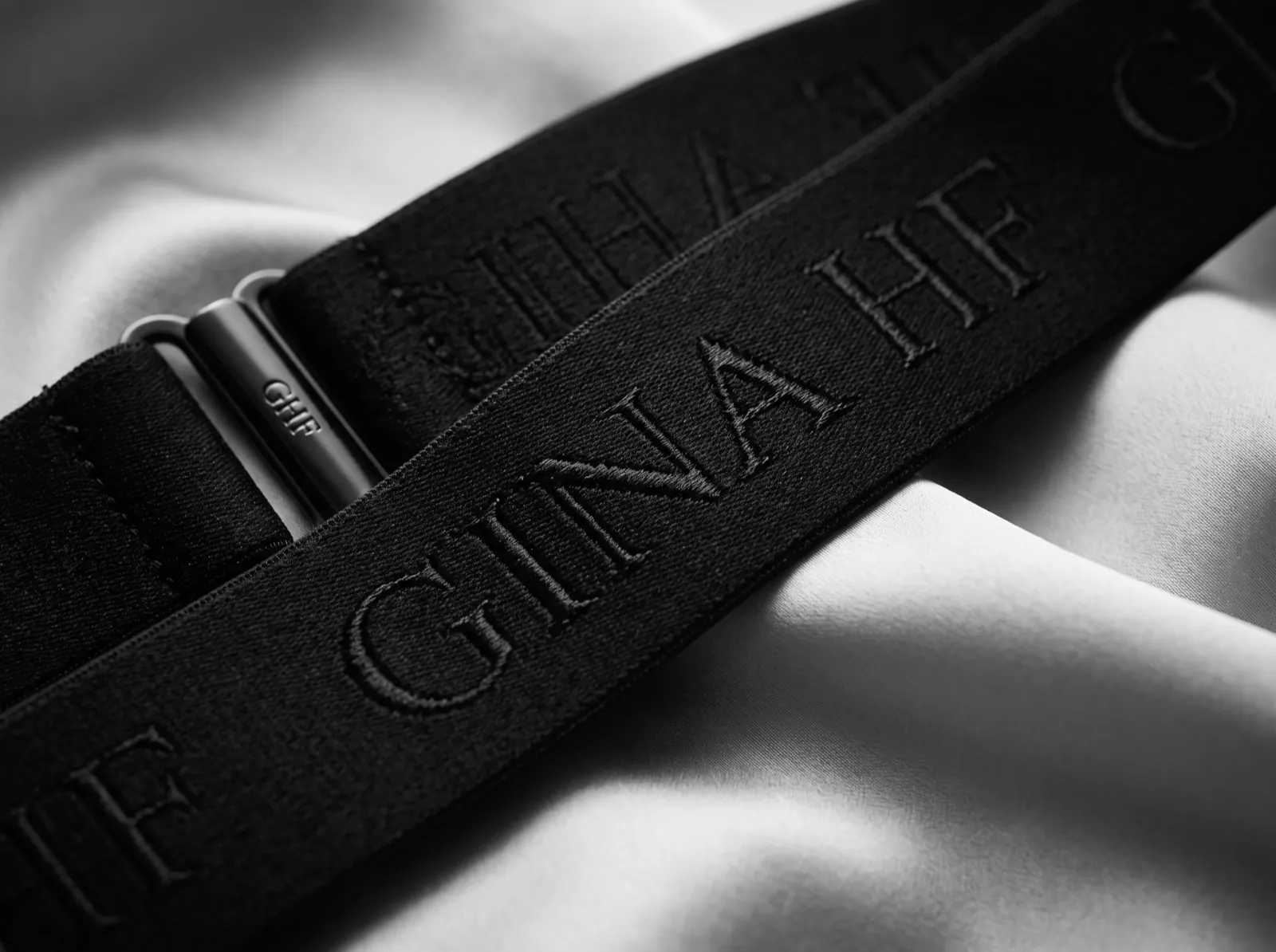
There is a whole category of intimate wear built on the opposite premise: the elastic printed edge-to-edge with a house name, the hardware oversized and gleaming, the band turned into a strip of advertising to be glimpsed above a waistband. It is not that this is vulgar — vulgarity is a tedious accusation and usually a class one. It is that it is structurally confused. That printed elastic is single-layer, because a two-layer power mesh band would obscure the print. The oversized hardware is plated zinc, because forged metal in that size would drag. The logo is not sitting on top of good construction. It is standing in for it. You are being sold the impression of a good garment by a garment that has spent its budget on being recognisable.
And recognisable to whom? This is the question that dissolves the whole proposition. A monogrammed band exists to be read. Lingerie is worn under clothes. The logic only closes if you assume an audience, and the moment you assume an audience you have left the territory this garment actually lives in.
What we do instead
We put the money where the hands go. Silk cut on the true bias, sixteen to twenty-two momme, so the cloth falls around the body instead of hanging off it — and hung for a full day before the hem is cut, because bias-cut cloth drops under its own weight and a hem levelled too early will hang crooked forever. French Chantilly and Leavers lace, chosen partly because their finished edges let us delete seams rather than add them. Two layers of power mesh in the band, cut on opposing grains. Wires forged, tipped, and closed into their channels by hand at both ends, which is the point where every cheap wire eventually escapes. Flatlock throughout. Adjustable straps on metal. And a woven label, sewn in, on a garment with no other mark anywhere on it.
Held at arm's length in a shop, none of this is visible. In the hand, it is unmistakable within seconds — which is exactly the register we want. Legible up close, silent at distance.
The hour that belongs to you
Consider what the day has asked of you. Consider how much of it was performed for someone: the meeting, the message answered at the traffic light, the tone kept even when it cost something. Almost every choice you made about how to appear was made with another person in the room. Then the door closes and the last hour of the day arrives, and it is the only hour with no audience in it at all.
So make it a form rather than a collapse. Run the water hot. Take the day off your face. Oil into the skin at the shoulders and the back of the neck, where you carry everything. Turn the lamp down to something warm. Then wear something that feels like silk against your skin, and dress beautifully for no one. Not for a partner, not for a photograph, not for later — for the twenty minutes between the bathroom and sleep, which belong to nobody but you.
That is the whole grammar, and it is shorter than the theory that surrounds it. The finest thing you own should be the thing nobody will ever compliment. Care for yourself like someone you love.