Fewer bows, fewer appliqués, more engineering. On the weight of tulle, the strap that stays, the band that never rides — and the confidence that comes from a garment that asks for nothing.
Understatement in lingerie is routinely mistaken for modesty — the choice of a woman who would rather not be looked at. It is nothing of the kind. The plainest piece in a good drawer is almost always the most expensive one to make, and almost always the one worn most. To choose it is not to withdraw. It is to have understood that the work a garment does on the body is a different thing entirely from the noise it makes on the hanger.
The economy of the hanger
A bra has a fixed budget: so many hours of cutting and sewing, so much cost in cloth and notions, so much room across the cup before the eye starts to see clutter. Every bow, every rhinestone slider, every appliqué draws from that budget. It is spent at the hanger, where the garment must attract you in eight seconds under bright retail light — and it is spent instead of the underband, the cup seam, the strap hardware, the things that will decide whether you are still comfortable at seven in the evening.
This is not a moral argument. It is arithmetic. A three-piece cup — the seam that runs under the apex and the seam that runs across it — takes roughly three times the sewing of a moulded cup and is the only construction that will genuinely lift and separate a full bust, because the seams themselves are the structure. A garment cannot carry both that seaming and a chest of ornament at the same price. The house spends it on the seams. That is the whole of the design philosophy, and it takes one sentence.
Where the support actually lives
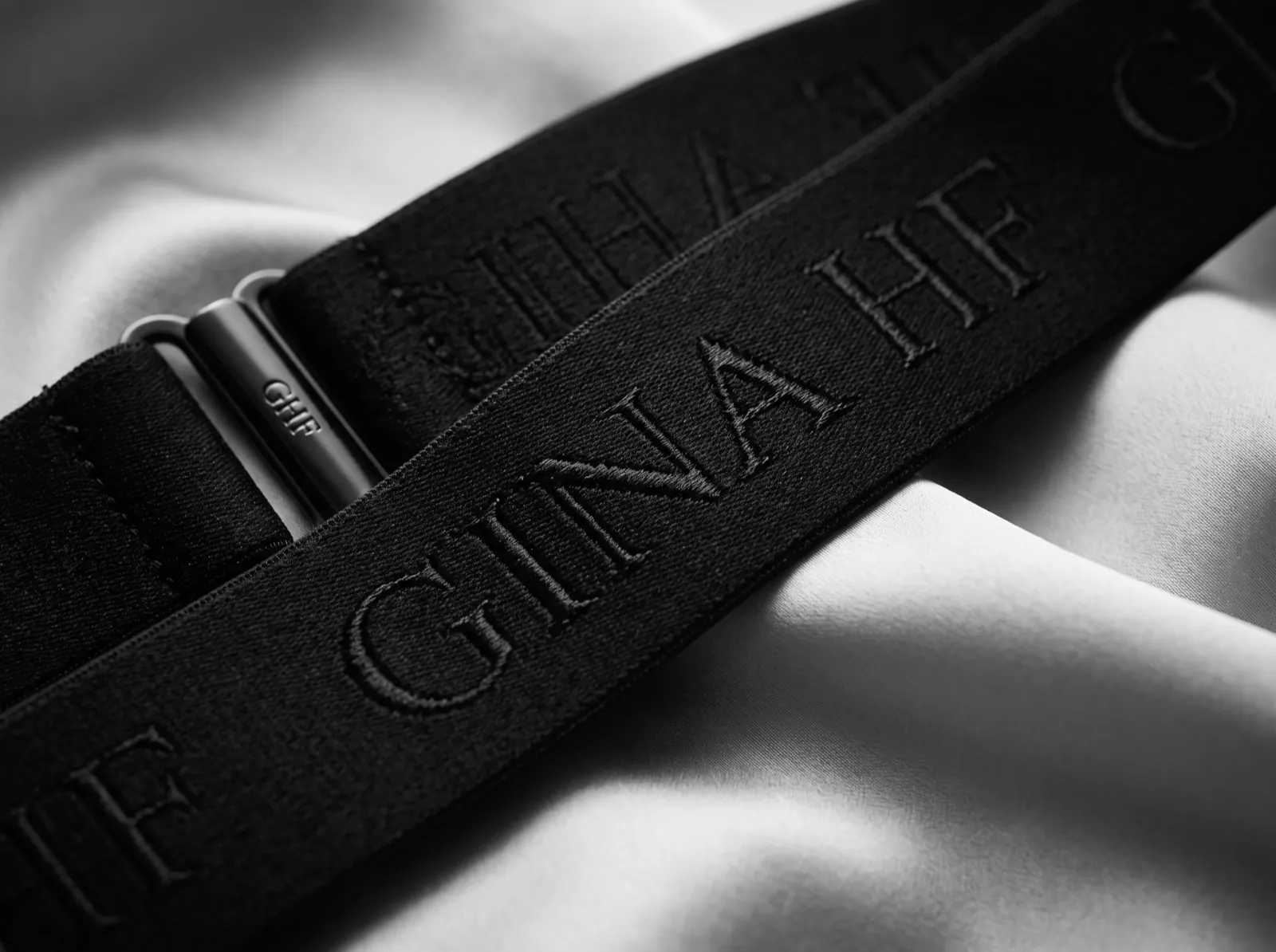
Around eighty per cent of a bra's support comes from the band, not the straps. Which means the most important thing in the garment is a strip of elastic you never look at. It must be firm enough to anchor against the ribcage and stay level all the way round; it must be wide enough to spread the load rather than cut; and it must be sewn on with a flatlock seam, so that the join lies flush with the cloth on both faces instead of standing proud of it. A flatlock takes a dedicated machine and about four times the operator time of an overlock. It is also the only reason a band does not print a ridge through a fine knit.
- The band sits level front to back and does not climb. If it rides up at the back, it is not doing its job — it is being pulled there by straps carrying weight they were never meant to carry.
- The underwire tracks the root of the breast tissue and stops there, lying flat against the ribs with no gap and no digging. A wire that floats is the wrong shape; a wire that stabs is the wrong width.
- The straps adjust, and once adjusted they stay — which is a question of hardware, not of tension. A slider in coated metal with a properly tight radius holds; a lightweight plastic one creeps down all day.
- The power mesh in the wings is cut on the stable grain, so the wing holds its length while the band does the stretching.
The weight of tulle
You can feel the quality of a tulle before you can see it. A fine French tulle used as cup lining is almost weightless in the hand and yet has a distinct dry crispness — it resists a little when you draw it between finger and thumb, and it springs back rather than collapsing. That resistance is what makes it work as a stabiliser inside a cup: it stops a bias-cut silk from stretching out of shape across the fullest part of the bust, without adding the stiffness of a fusible interfacing, and without ever being visible.
Lace behaves the same way. A Leavers lace has a woven selvedge along both edges — a finished border, made on the loom, that can be used as the top edge of a cup with no hemming at all. A mechanically-made lace does not; it must be cut and bound, and that binding is a ridge under clothing. The difference is invisible in a photograph and unmistakable at the neckline of a fitted shirt. This is the whole category of things that are noticed without being seen.
“The pieces we are proudest of are the ones a woman forgets she is wearing. A garment that asks for attention all day has failed at the only work we gave it.”
The fitting room, Bangkok
What restraint costs the maker
Plain construction is unforgiving. Ornament is, among other things, a place to hide: a bow at the centre gore covers a join that did not quite meet; a scatter of appliqué distracts from a cup seam that wanders. Strip those away and every millimetre is on show. The gore must lie flat against the sternum with no daylight behind it. The two cups must mirror each other exactly, which means the grading was right at every size and not merely scaled. The elastic must be applied at a consistent tension — too loose and it ripples, too tight and it gathers — over the whole curved length of the neckline, by hand, by someone who has done it long enough to feel the tension rather than measure it.
Confidence as a by-product
There is a particular quality women describe after a proper fitting, and it is almost never described as feeling attractive. It is described as forgetting. The straps are not being pulled up in a meeting. The band is not being tugged down in a lift. The wire is not being thought about at four in the afternoon. All the small attentional taxes a badly-fitted garment levies across a day are simply not levied, and what returns is the attention itself.
That is where the confidence comes from — not from ornament, and not from being looked at. It comes from a garment that has stopped making demands. A piece that announces itself is asking you to manage it. A piece that says nothing has already done its work, silently, hours ago, and left you free to be about your own day.
The ritual
So make a small ceremony of it, at the end of the day rather than the start. Unhook the band. Rinse the silk in cool water with your hands, the way you would wash something alive. Lay it flat. Choose tomorrow's while tonight's is drying — not for anyone, not for an occasion, simply because the next day deserves the same care as this one. Dress beautifully for no one. It is the only audience whose opinion follows you into every room you will enter.
Understatement, in the end, is not a look. It is a standard applied where no one is checking. What you choose to wear under everything is the one decision of the day made entirely for yourself — and the quiet of a garment that asks for nothing is how that decision sounds.