A snagged lace, a slack band, a slipped strap — none of them is a verdict. On the quiet dignity of repair, and the specific techniques that keep a piece in the world.
Somewhere along the way we were taught to read damage as a verdict — a pulled thread in lace, a strap that will no longer hold its setting, a band gone slack, each announcing that a garment's time was up and a replacement was owed. It is a strange lesson, and a recent one. For most of the history of beautiful clothes, a fault was simply an invitation to sit down with a needle. To mend a thing is to say, in the most practical language there is, that you intend to keep it.
The garment that can be repaired at all
Not everything deserves mending, and this is the honest part. A piece built to be discarded resists repair by construction: its edges are bonded rather than stitched, its cups moulded in one piece so there is no seam to reopen, its elastic laid under a fused tape that cannot be lifted without destroying the face fabric. A well-made piece is the opposite. Stitched seams can be opened along their original line and closed again. Elastic applied over a folded edge can be unpicked and replaced. Hardware is mechanical and therefore swappable. When we say a garment is made to last, a large part of what we mean is that it was made to be taken apart.
“A mend is not a scar on a garment. It is proof it was worn enough to be worth the trouble.”
The atelier — GINA HF, Bangkok
What can almost always be saved
Far more than most women imagine. These are the repairs we do most often, and roughly what each involves:
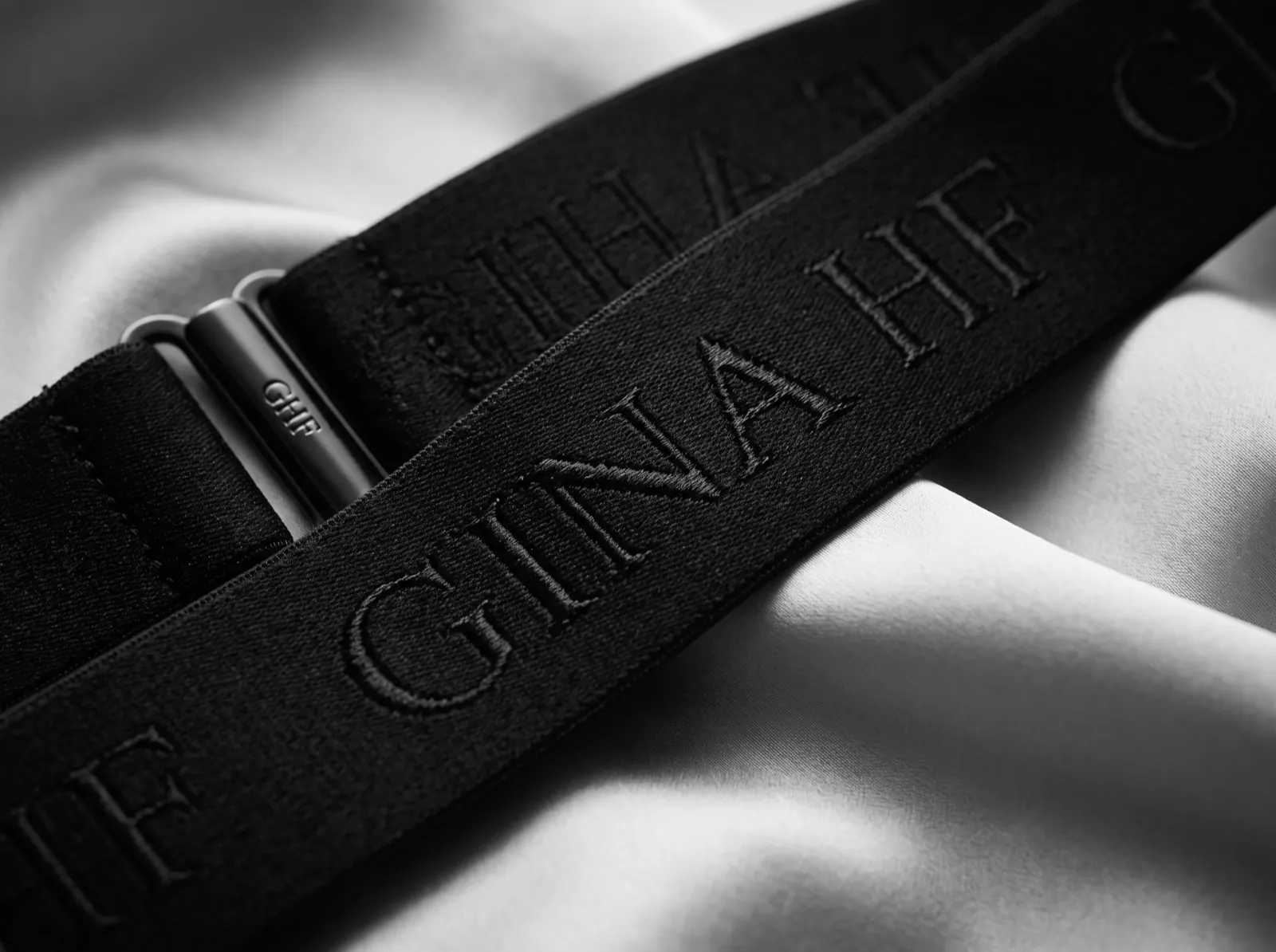
- A slack underband. The single most common fault, and the most rewarding to fix: the old elastic is unpicked and new elastic set at the correct ratio, restoring the band to its original tension. Since the band carries the great majority of a bra's support, this is effectively a new garment for the cost of an hour.
- A slipping strap. Usually a worn slider whose grip has polished smooth, or an elastic that has lost recovery. Both are replaced in minutes.
- A wire that has worked through its casing. The wire is removed, the casing repaired or renewed with a new channel and a bar tack at each end, and the wire replaced — never trimmed, and never simply pushed back through the hole it made.
- A snagged or torn lace. A pulled loop is coaxed back with a fine needle rather than cut. A genuine tear is repaired by appliqueing a matching motif over it, following the outline of the pattern, so the repair reads as part of the design.
- A failed hook-and-eye tape. The tape is replaced entirely; it is a five-minute operation and it is why so many bras are discarded for no good reason.
- A dropped hem on a silk slip, re-rolled by hand and often stronger than it began.
The honest limit
There is a boundary and we will not pretend otherwise. Elastane degrades. Every elastic in every garment loses recovery over time — faster with heat, with chlorine, with the tumble dryer, with body oils left in the fibre by washing too seldom. When a garment's fabric itself has thinned to translucency at the wing, or when the mesh has lost its snap across the whole body of the piece rather than at one edge, replacement of a component will not save it. Repair extends a life; it does not confer immortality. Knowing which of the two you are looking at is part of caring for things properly.
Visible mending, and the beauty of the seen repair
The Japanese kept a word, sashiko, for stitching that does not hide — a repair worked deliberately and evenly, refusing to pretend the garment was never hurt, making a small grace of the fact that it was. Lace lends itself to this beautifully. A darned scallop, or a motif laid over a tear in a slightly different tone, becomes an ornament with a history. There is a confidence in it that disposable clothing cannot imitate, because disposable clothing has nothing worth the needle.
How to make a repair less necessary
Most of what we repair was caused by care rather than by wear. Machine agitation abrades lace. The tumble dryer is the fastest way in existence to kill elastane. Hanging a wet silk slip stretches the shoulder line permanently. And wearing the same piece two days running gives the elastic no time to recover — a garment rested for a day after each wearing will hold its band tension for years longer than one worn continuously. Rotation is not a luxury habit. It is the cheapest repair there is, performed in advance.
We keep our doors open to the pieces we have made. Bring one back that has earned its wear and we will repair it — not as a courtesy, but because a garment returned for mending is the highest review a house can receive. The most sustainable piece in the world is the one already in your drawer, kept there one repair at a time.