Lingerie lives a shorter life than a coat — and that is exactly why construction matters more, not less. What separates five years of wear from five months.
There is a test, quiet and unforgiving, that no campaign can pass on a garment's behalf: time. A piece either survives years of wearing or it does not, and almost everything that decides the outcome is invisible on the rail — sewn inside the seams, present in the parts you cannot see and absent in the ones you can.
First, an honest concession
A well-made coat can be handed to a daughter. A bra cannot, and we will not pretend otherwise. Intimate garments are worn against skin, laundered far more often than outerwear, and built around elastane — a fibre that degrades with heat, with body oils, with chlorine, and simply with the number of times it has been stretched and released. Even impeccably made and impeccably cared for, an underwired bra worn in regular rotation is doing well at five years. A silk slip may go considerably longer; a piece of elastic will not.
The conclusion people draw from this is precisely backwards. If a category has a shorter natural life, the quality of what is inside it matters more, not less — because the difference between a badly made piece and a well-made one is not the difference between five years and six. It is the difference between four months and five years, repeated across a lifetime of purchases. Nowhere in a wardrobe does construction compound faster.
“We design as though the woman will still be reaching for this piece in her fifth year of owning it. It changes every decision inside the garment.”
GINA HF — Bangkok
The materials decide first
No amount of fine sewing rescues a poor cloth. True mulberry silk of adequate weight ages into itself — it softens, it drapes more truthfully, it takes a decade of gentle washing. Power net with a high-quality elastane core recovers its shape after each wearing for years; a cheap net loses its snap within a season and no seam can restore it. Leavers and Chantilly lace, made on slow narrow looms, remain supple and hold their scallop long after a bonded synthetic lace has gone brittle and begun to shed at the edges. Before a single stitch is considered, most of a garment's lifespan has already been written into the order sheet.
The construction that buys you years
Inside a piece made to last is a set of quiet, costly choices, each of which a faster maker omits to save minutes and cents:
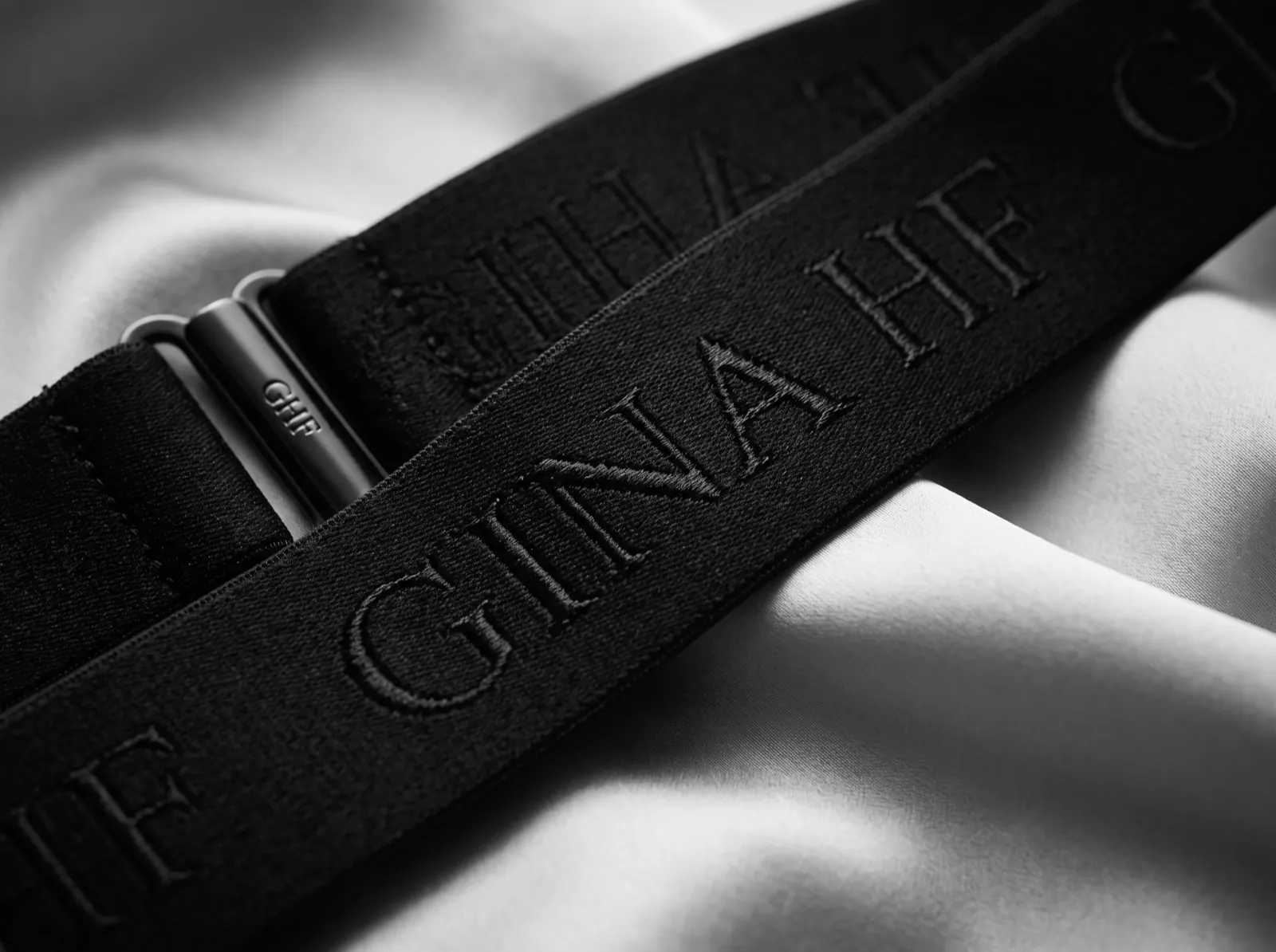
- Elastic applied at a measured, consistent ratio and stitched down, rather than fused. A stitched elastic can be replaced when it tires; a bonded one cannot, and its failure ends the garment.
- Cup seams sewn flat and topstitched down rather than overlocked. This costs roughly four times the machine time and delivers two things at once: no ridge against skin, and a seam that will not abrade itself from the inside.
- Bar tacks at every load-bearing junction — where the strap meets the ring, where the wire casing terminates, where the band meets the closure. These are the four or five points that take the entire mechanical life of the garment.
- A properly finished wire casing with a closed, reinforced end, so the wire cannot work its way through. A wire escaping its channel is the single most common cause of an otherwise sound bra being thrown away.
- Hardware in metal rather than moulded plastic, and a hook-and-eye tape that can be unpicked and replaced.
- Fine, appropriate thread in an appropriate weight, so the stitching wears at the same rate as the fabric rather than cutting through it.
How to read these things in your hand
You need no atelier to judge a garment's future. Turn it inside out — the inside tells the truth the outside is selling. Run a fingertip along a cup seam: does it lie flat or stand as a ridge? Stretch the underband gently and let it go; a good band snaps back to its exact original length, a poor one returns lazily and slightly longer. Look at the ends of the wire casing for a bar tack. Check whether the lace was joined by an applique that follows the motif or butted together in a straight seam that cuts a flower in half. A garment built to last does not hide its construction. It invites the inspection.
And then the wearer's half of the bargain
Construction sets the ceiling; care decides how close you come to it. Rest a piece for a day between wearings so the elastic can recover. Wash by hand in cool water, or in a mesh bag on the most delicate cycle, and never in hot. Never tumble dry — the dryer destroys elastane faster than years of wear. Dry flat, not hanging. Store cups nested rather than folded inward, which permanently creases the moulding. Done consistently, these habits routinely double the working life of a well-made piece, and no habit at all can rescue a badly made one.
This is the only sustainability that survives contact with reality: fewer garments, better made, worn longer, repaired when they can be. Not a certificate. A drawer of things that still fit and still hold, years after they were bought.