A guarantee is only worth what it costs to honour. What GINA HF commits to on fit, materials, repair and lifespan — and what we deliberately refuse to promise.
Most guarantees in fashion are written by people hoping never to be asked to honour them. They are vague on purpose — quality, craftsmanship, excellence — because vague language cannot be tested. We would rather write ours in terms specific enough that you could hold us to them, and then live with the consequences of having done so.
What follows is what this house commits to, and, just as importantly, what it does not.
What we guarantee about materials
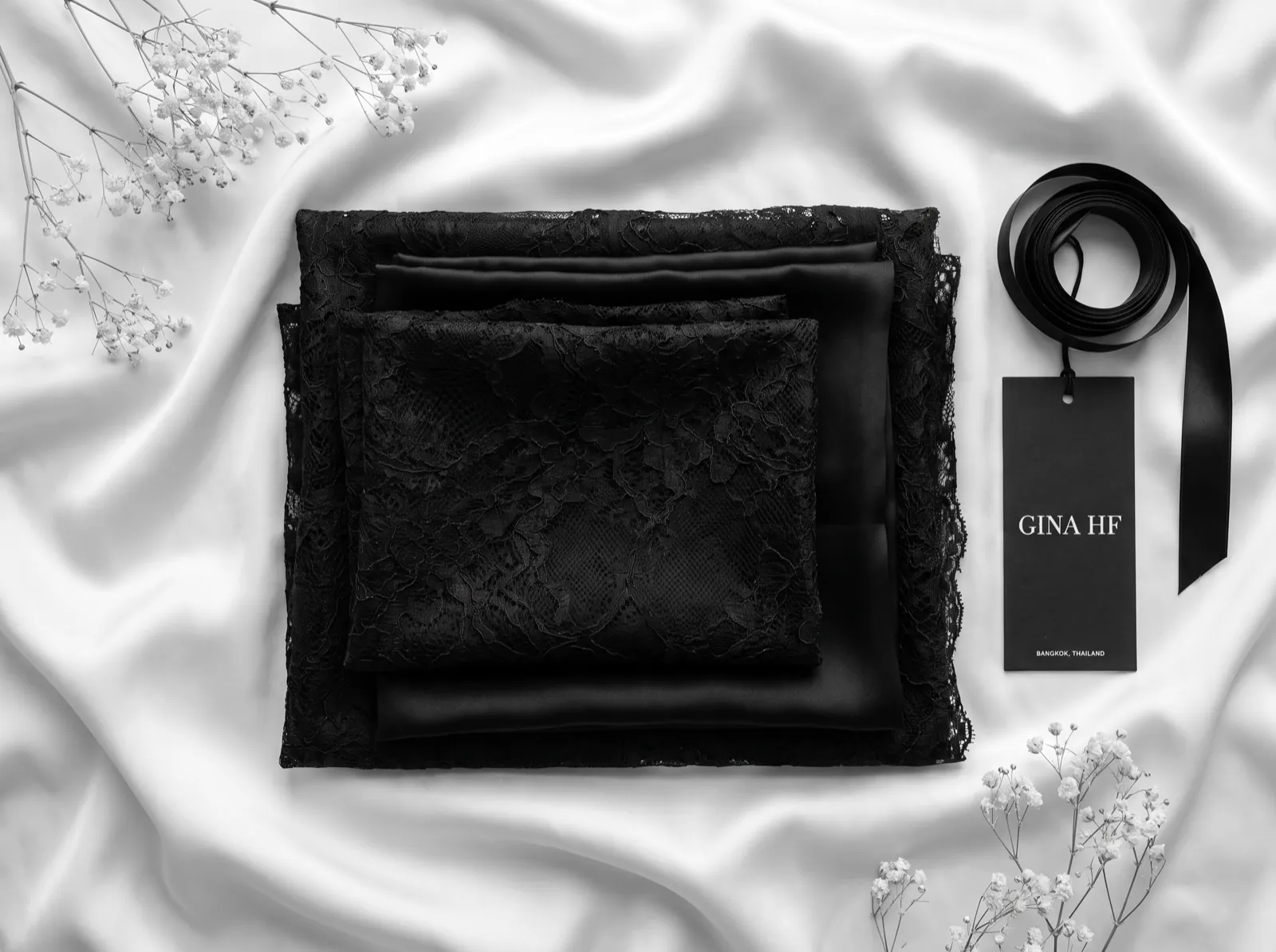
Every silk we use is mulberry silk, named by weave and by momme on the product page — crêpe de Chine at a stated weight, charmeuse at a stated weight — because those two numbers determine almost everything about how a garment will behave and neither can be assessed from a photograph. We do not use the word silk to describe a blend. If a piece contains anything other than silk, the full composition is stated in full, including the elastane content of every elastic component.
Our lace is French: Chantilly for the fine floral grounds, Leavers where we need the density and dimensionality that only those looms produce. Our power mesh and stretch tulle are Italian. Our elastics are selected for recovery under repeated load, tested to a minimum of three hundred stretch cycles before a style is approved, and replaced in the specification if they fail. We name the country of origin of every component honestly, which sometimes means naming four countries for one garment.
What we guarantee about fit
Every style is developed on live fittings across the full size range, not graded up and down from a single sample size. This distinction is the single most consequential thing in our category and almost nobody does it, because it is slow. Standard industry practice is to fit one middle size properly, then apply a mathematical grade rule to generate every other size. It works reasonably for a straight-cut garment and it fails badly for a cup, because breast tissue does not scale proportionally: the root width, the projection, the tissue distribution and the position of the apex all change at different rates.
So we fit at intervals across the range and correct the pattern at each one. A larger cup gets a proportionally wider wire and a deeper cradle, a higher-modulus band elastic, a wider strap set closer to the neck so it does not slide off the shoulder, and often an additional seam to distribute the load. These are not scaled versions of the small size. They are different garments that happen to share a design language.
- Composition and silk momme stated in full on every product page. No use of 'silk' for a blend.
- Every size fitted on a live body, not graded mathematically from a single sample.
- Elastics cycle-tested before approval; any component that loses recovery is re-specified.
- Free alteration within ninety days of purchase — band, strap and cup adjustments.
- Repair offered for the lifetime of the garment: replacement elastics, hardware, hook tape, seam repair.
The repair commitment, and why it exists
In a well-made bra, the elastic components fail long before the fabric does. Band elastic loses meaningful recovery somewhere between eighteen months and three years of regular wear, depending on frequency and how it has been washed. When it goes, the garment stops supporting — and the standard response, industry-wide, is that the wearer buys another one.
This is absurd. The silk is intact, the lace is intact, the cups have not moved. What has failed is roughly ninety centimetres of elastic and two small pieces of hardware, all of which can be replaced by a skilled maker in under an hour. We do that replacement for as long as the garment exists, at the cost of materials and labour and nothing more. It is not generosity; it is the logical consequence of having built the garment to last in the first place. A house that will not repair its own work is telling you what it privately believes about that work.
What we refuse to promise
We will not tell you that a garment will fit perfectly ordered from a size chart. Commercial sizing is a coarse instrument applied to an extremely variable object, and any house claiming otherwise is either not thinking about it or hoping you will not return the piece. We expect that a meaningful proportion of first orders will need adjustment, which is exactly why the alteration is free and built into our costing rather than treated as a failure.
We will not promise that a silk piece is unaffected by careless washing. Silk is a protein fibre. Hot water, alkaline detergent, chlorine and prolonged direct sun will damage it, and no finish we could apply would change that without changing the hand of the cloth into something you would not want against your skin.
And we will not promise that our pieces will transform how you feel. That claim is made constantly in our category and it is not ours to make. A garment can remove a set of small daily frictions and it can be beautiful. What a woman does with the attention that frees up is entirely her own business.
“A guarantee is only worth what it costs the house to honour it. Ours costs us something every month, which is how we know it is real.”
GINA HF — Bangkok
Why put it in writing
Specific commitments constrain a business. Free alterations mean employing fitters. Lifetime repair means keeping component stock for discontinued styles and a bench with somebody skilled at it. Live fitting across the size range means a development cycle several times longer than the industry norm. Every one of these is a reason a growth-minded operator would advise against writing any of it down.
We wrote it down anyway, because a promise that costs nothing to keep is not a promise — it is copy. The point of stating terms this precisely is that they can be checked, and that you are entitled to check them.