Quiet luxury in lingerie is not the absence of decoration. It is a set of expensive construction decisions that a wearer feels and a photograph cannot show.
The phrase quiet luxury has been worn thin, mostly by people using it to mean beige. In our category it has come to describe a look: an unlogoed bralette in oat-coloured jersey, shot on a rumpled bed. We would like to propose a more useful definition, because the one thing quiet luxury genuinely describes is a set of choices that cost real money and produce no visible evidence.
Loud luxury spends its budget where it can be seen: the appliqué, the hardware, the branded elastic. Quiet luxury spends it where only the wearer will ever find it. The difference between the two, in a lingerie house, is measurable to the minute and to the baht.
Where the money goes when nobody can see it
Take the inside of a silk slip. There are three honest ways to finish the internal seams. An overlocked edge takes about eight seconds per seam and leaves a bulky, slightly abrasive chain of thread that will show as a ridge under a fine dress and, over a year, will abrade the silk beside it. A bound edge is neater but adds bulk. A French seam — where the pieces are sewn wrong sides together, trimmed close, pressed, turned and sewn again so the raw edge is sealed inside a channel — takes roughly four times as long, requires two passes and a press between them, and leaves the inside of the garment as clean as the outside.
On a slip with six seams, that is the difference between under a minute and about five minutes of machine time, plus pressing. Across a production run it is significant. And the only person who will ever encounter the result is the woman wearing it, at the point where the seam does not scratch her ribs at the end of a long day. That is the transaction quiet luxury actually describes.
Five decisions a photograph cannot show
- French seams instead of overlocking: four times the labour, no raw edge, no ridge under a fine shirt.
- Cup seams pressed open and topstitched flat rather than pressed to one side: no internal step against tissue.
- Strap elastic selected by modulus rather than by width — it must give under load and recover fully by the next morning.
- Hook-and-eye tape backed with a soft brushed facing, so nothing metal contacts the spine.
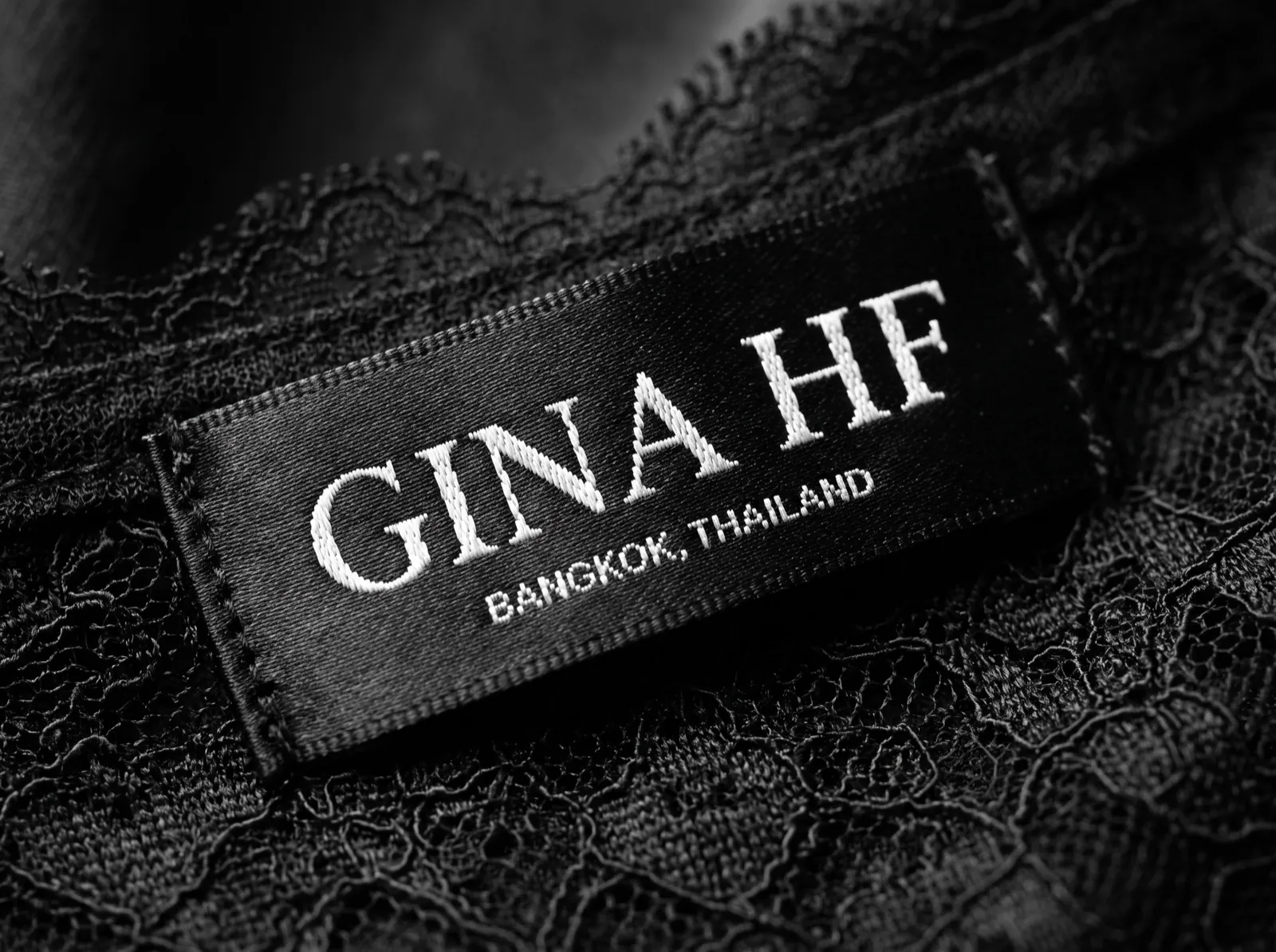
- Labels printed on soft satin and set into a seam, or omitted entirely and heat-transferred. A woven label is a scratch with a logo on it.
That last item is worth dwelling on, because it is the perfect illustration. A woven label at the centre back of a bra band sits directly against the spine, at the exact point where a chair back presses. It is stiff, it has cut edges, and after two hundred washes it becomes stiffer. It exists for one reason: to identify the maker. It is, in the most literal sense, decoration at the wearer's expense. Removing it costs a house its most visible internal branding and gains the wearer eight hours a day of not being poked. We consider that trade obvious.
Restraint is not minimalism
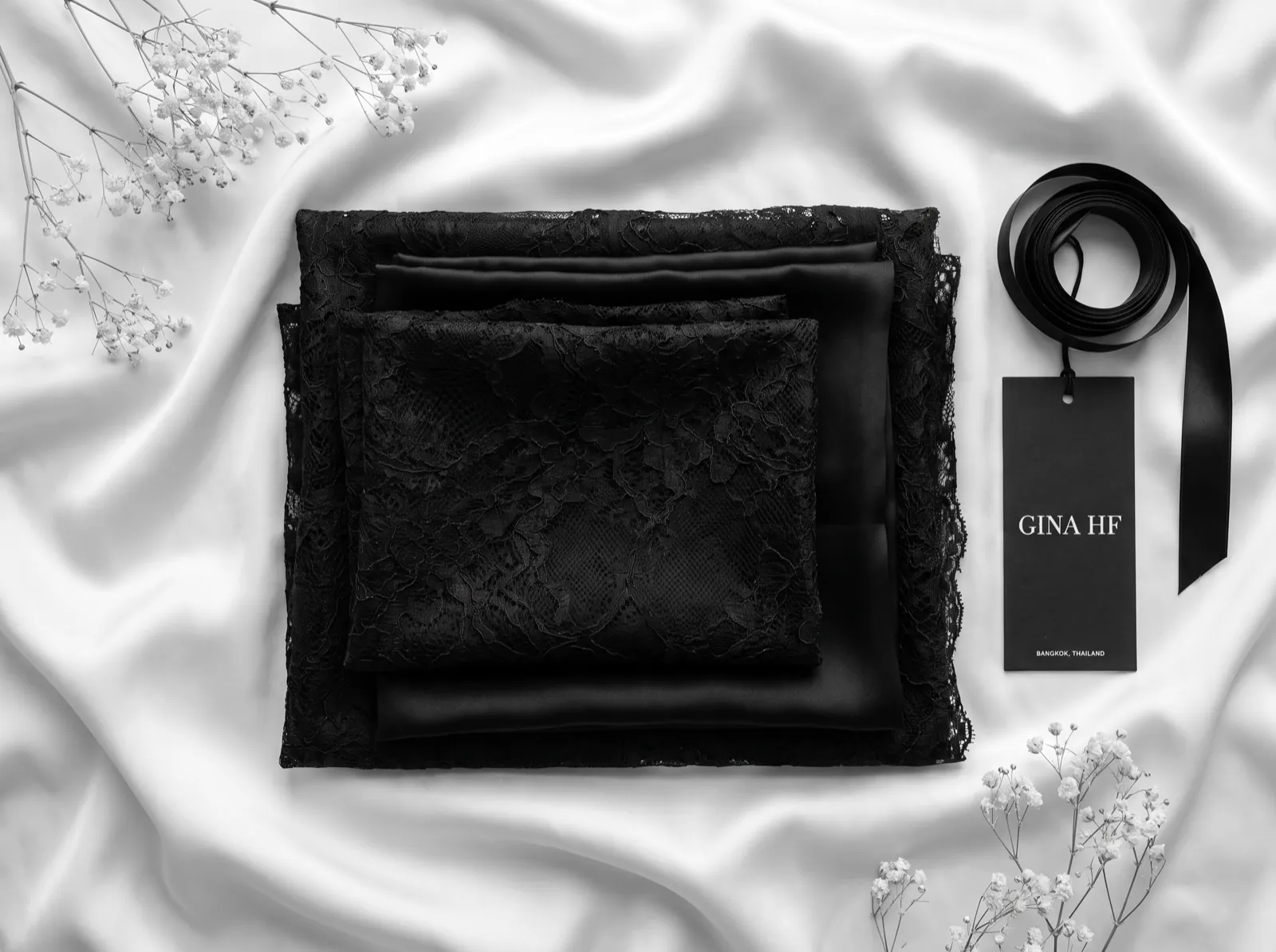
It is important to say that quiet does not mean plain. Our most restrained pieces contain hand-appliquéd Chantilly, where the lace motif is cut along its own scalloped outline and stitched to the tulle beneath with a fine invisible stitch, so that the pattern appears to float without any seam crossing it. That is several hours of hand-work on a single piece. It is also, from three metres away, almost invisible — you read a texture rather than a decoration.
The distinction we are drawing is not between decorated and undecorated. It is between decoration that announces itself and decoration that rewards proximity. A Chantilly motif that has been butted invisibly at the side seam so the pattern runs continuously around the body is far more expensive than one where the lace is simply cut and joined. Nobody photographs it. The woman who owns it notices, once, and then knows something about the object she owns for as long as she owns it.
The test we apply
When the house is deciding whether a detail earns its place, we ask a single question: does this improve the experience of the person wearing it, or the experience of the person looking at her? Both answers are legitimate in different businesses. Ours only builds for the first.
This rules out a surprising amount. It rules out most decorative hardware, which is heavy and cold and catches on knitwear. It rules out the fashionable strapping detail across the back, which looks striking in a photograph and marks the skin within two hours. It rules out most contrast trims, which require an extra seam somewhere it is not needed. What survives the test is a small, coherent vocabulary — and that coherence is what reads, from a distance, as taste.
“We are not trying to be seen restrained. We are trying to build something that is still comfortable at the end of a fourteen-hour day, and restraint is what that turns out to look like.”
The atelier, Bangkok
How to check any of this for yourself
You do not need our word for any of it. Turn a piece of lingerie inside out — your own, ours, anyone's. Run a fingertip along every internal seam and ask whether you would want that surface against your skin for a working day. Pull the band gently and watch whether it returns to its original length or stays slightly stretched. Look at the centre back: is there something stiff there with a name printed on it? Check whether the lace pattern continues across the side seam or simply stops.
Four checks, two minutes, and no expertise required. They will tell you more about how a garment was made, and how it will treat you in a year, than any description ever written about it — including this one.