
The house names its foundation pieces after the unwatched hours — the ones a woman spends entirely in her own company. On why those hours, and not the spectacle, are our subject.
A nocturne is a piece of music written for the night — not for a performance hall, but for the hours when a house has gone quiet and nobody is listening except the person playing. That is the whole idea in a word. The unwatched hours at either end of a day, the grey-blue one before the sun and the low-lit one after it, are the only parts of a day that have not been allocated to anyone else.
We named our foundation pieces after them because those are the hours the pieces were designed for. Naming a lingerie collection after the moment someone else walks into the room would have told an untruth about what we believe this category is actually for.
Against the spectacle
The dominant grammar of lingerie is spectatorial. The garment is imagined as the last layer removed, in a low light, in front of someone. Everything follows from that premise: the marketing, the fit priorities, the willingness to accept a garment that is uncomfortable because it is only meant to be worn for an hour and looked at rather than lived in.
We think this premise has produced a great deal of badly made clothing. A garment designed to be looked at for an hour can afford a hard-edged elastic, a seam that sits directly over the breast root, a strap that will not survive a full range of arm movement. A garment designed to be worn from six in the morning until eleven at night cannot afford any of these things. The performance requirements are simply not the same, and holding ourselves to the harder one made everything better — including, incidentally, how the pieces look.
What first light asks of a garment
Consider what actually happens in that first hour. The body is warm from bed, slightly swollen, at its most sensitive to texture. It moves through a sequence of unglamorous motions: reaching, bending, standing at a window, holding a cup. Anything that scratches will be noticed immediately and resented for the rest of the day. Anything that grips will be removed.
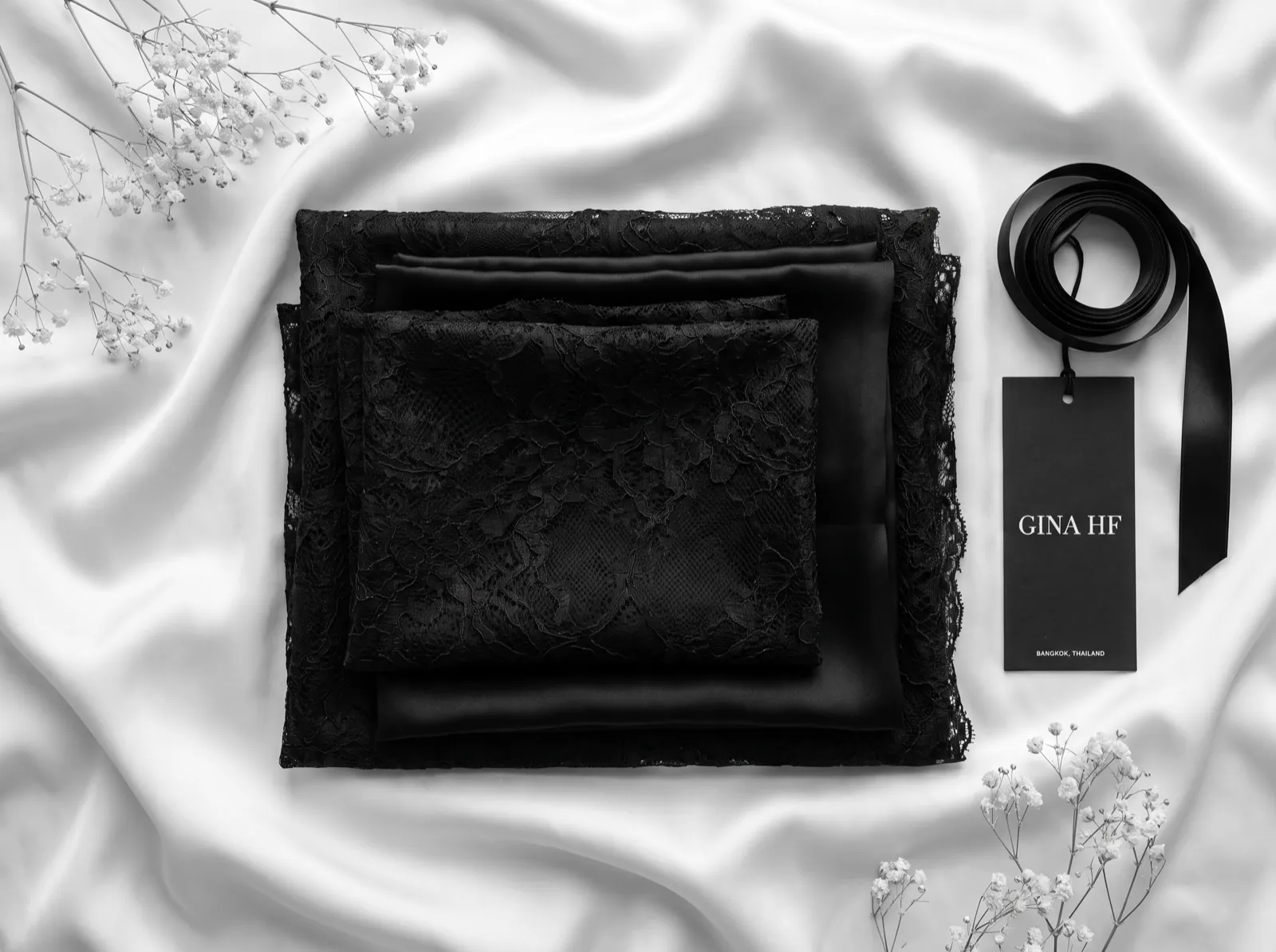
So the Nocturne pieces are built to a set of rules that come directly from that hour. Silk crêpe de Chine at a weight that stays cool against warm skin. French seams throughout, so that the raw edge is enclosed and the inside of the garment is as finished as the outside. No hard elastic anywhere that meets skin at rest — where we need hold, we get it from a picot-edged elastic with a soft face, or from the cut of the cloth itself. Bias panels through the body, so the fabric moves with the torso rather than resisting it.
- Silk crêpe de Chine, chosen for its dry hand and its behaviour against warm skin.
- French seams enclosing every raw edge — four times the work of an overlock, and no scratch anywhere inside.
- Bias-cut body panels so the cloth follows the torso instead of hanging across it.
- Soft picot elastics at the edges, never a hard-cut band where it meets bare skin.
- Straps set on the true bias so they lengthen slightly under load and recover, rather than digging.
The bias, and why it belongs here
Cutting on the bias means laying the pattern at forty-five degrees to the warp and weft. At that angle a woven cloth gains an elasticity it does not otherwise possess — not the stretch of a knit, but a willingness to elongate and narrow under its own weight and then settle. The technique reached its high point in the 1930s in evening dress, and it is often described as a way to make cloth cling. That description misses the point.
The real virtue of the bias is that it lets a woven garment accommodate change. A body is not the same size at seven in the morning as it is at nine at night, and it is not the same across a month. Straight-grain cloth records that variation as strain: it pulls, it marks, it announces the difference. Bias cloth absorbs it. It is the closest a woven fabric comes to forgiveness, which is exactly the quality you want in the first thing you put on.
It is also expensive. A bias layout consumes far more cloth than a straight one, cannot be nested efficiently, and demands that the cut pieces hang for at least a day before they are sewn so the fabric can settle into its own length. Skip the hanging and the hem will drop unevenly within a week of wear. Almost nobody hangs anymore. We hang.
“Dress beautifully for no one. That is the whole instruction, and it is the hardest one in the language.”
GINA HF — Bangkok
A collection as an argument
There is a version of self-care that is entirely purchasable and entirely hollow — a candle, a phrase in a serif font, a suggestion that a woman deserves a small treat. We have no interest in it. What we mean by the first hour is more demanding than that: it is the practice of extending to yourself, once a day, the same quality of attention you spend without hesitation on everyone else. Not a treat. A standard.
A garment can hold that standard in a way a slogan cannot, because a garment either performs or it does not, every day, for years. If a slip is still hanging true after three hundred wearings, that is not a message about self-worth. It is a demonstration of it. This is what the house is trying to make, and this is why it is named after the hour before anyone is watching.