
The woman who runs the room chooses her first layer before anyone sees her. On why the garment nobody photographs sets the tone for the entire day.
There is a moment, most mornings, that no one else witnesses. It happens before the coffee, before the first message answered, before the face is composed for the day. A woman stands in front of a drawer and decides what will sit against her skin for the next fourteen hours. It is the least public decision she will make and, we would argue, one of the most consequential — because it is the only one she makes purely for herself, and because she will feel its consequences continuously, in a way she will feel almost nothing else she puts on.
We built this house around that moment. Not around the evening, not around the audience, not around the photograph. Around the quarter of an hour before the day begins, when a woman is alone with her own body and decides how she intends to be treated by it.
What a badly made bra actually costs
Ask any woman who spends her day standing, presenting, travelling, negotiating, and she will describe the same low-grade tax: the strap that migrates, the underwire that lands on a rib instead of below the breast root, the band that rides up between the shoulder blades because it was cut too loose and so asked the straps to do work they were never engineered for. None of these are dramatic. Each of them costs a small, continuous portion of attention. Fourteen hours of small adjustments is a real subtraction from a person's day, and it is entirely avoidable.
The engineering truth is unglamorous and worth repeating: roughly eighty per cent of the support in a well-made bra comes from the band, not the straps. The band is a horizontal structure working in tension around the ribcage; the straps only stabilise. When a band is cut generously — as it usually is in volume manufacture, because a loose band fits a great many people badly rather than fitting anyone well — the load transfers upward onto two narrow strips of elastic crossing the trapezius. That is the mechanism behind the end-of-day ache most women assume is simply the price of having a body. It is not. It is a specification failure, and it is repeatable enough to be designed out.
Support is not the same as restriction
The house works from a distinction that took us a long time to articulate properly. A garment can hold a body without gripping it. Restriction compresses tissue and shortens the breath; support redistributes weight along structures built to carry it. The difference lives in details a wearer never sees: a power mesh cut on the cross-grain so that it stretches in one direction and holds in the other; a wire chosen for the width of a particular breast root rather than a nominal size; a cradle seam placed to lift from beneath rather than flatten from the front; a strap elastic with a low enough modulus to give under a reaching arm and return without stretching out by afternoon.
Get these right and the wearer's experience is simply an absence — nothing pinches, nothing slips, nothing asks for her attention. That absence is what we are actually making. It is a difficult thing to photograph and an easy thing to feel.
- The band carries the load. If it rides up at the back, it is a size too large, whatever the label says.
- Straps stabilise; they do not support. Tightening them to compensate for a loose band moves the strain to the shoulders.
- An underwire should sit on the ribcage all the way around the root of the breast, never on tissue.
- Silk against the skin is not indulgence — it moves with the body and holds far less moisture than synthetic jersey through a long day.
- Flat-seamed construction removes both the ridge that shows through a fine shirt and the friction point that wears a body down by evening.
The garment nobody sees
We are aware of the argument that all of this is invisible and therefore optional. We think the argument is precisely backwards. Every other garment a woman wears is at least partly a message to other people. The first layer is the only one that is not. It is chosen without an audience, worn without acknowledgement and removed without comment — which makes it the one entirely honest article in a wardrobe. A woman who dresses that layer well is not performing anything. She is deciding, privately, that she is worth the same care she extends to everyone else all day.
This is why we resist the language of seduction that clings to our category. It is not that we find it embarrassing; it is that it locates the value of the garment in someone else's gaze. The women this house was built for are not waiting to be looked at. They are running things. Their sensuality is not a display — it is a fact about how they inhabit a day, and it belongs to them before it belongs to anyone.
“You take care of everyone. This is where you take care of you — quietly, first thing, before the day asks anything of you.”
GINA HF — Bangkok
How the house works
Our patterns are developed in Bangkok on live fittings, not on standardised forms alone. Each style is built first in toile, worn for a full working day by a fitter, and corrected on the basis of what the day did to it — where it moved, where it marked, where it gave up at hour nine. A bra that fits beautifully for ninety seconds in a fitting room and fails at four in the afternoon has not been developed. It has only been photographed.
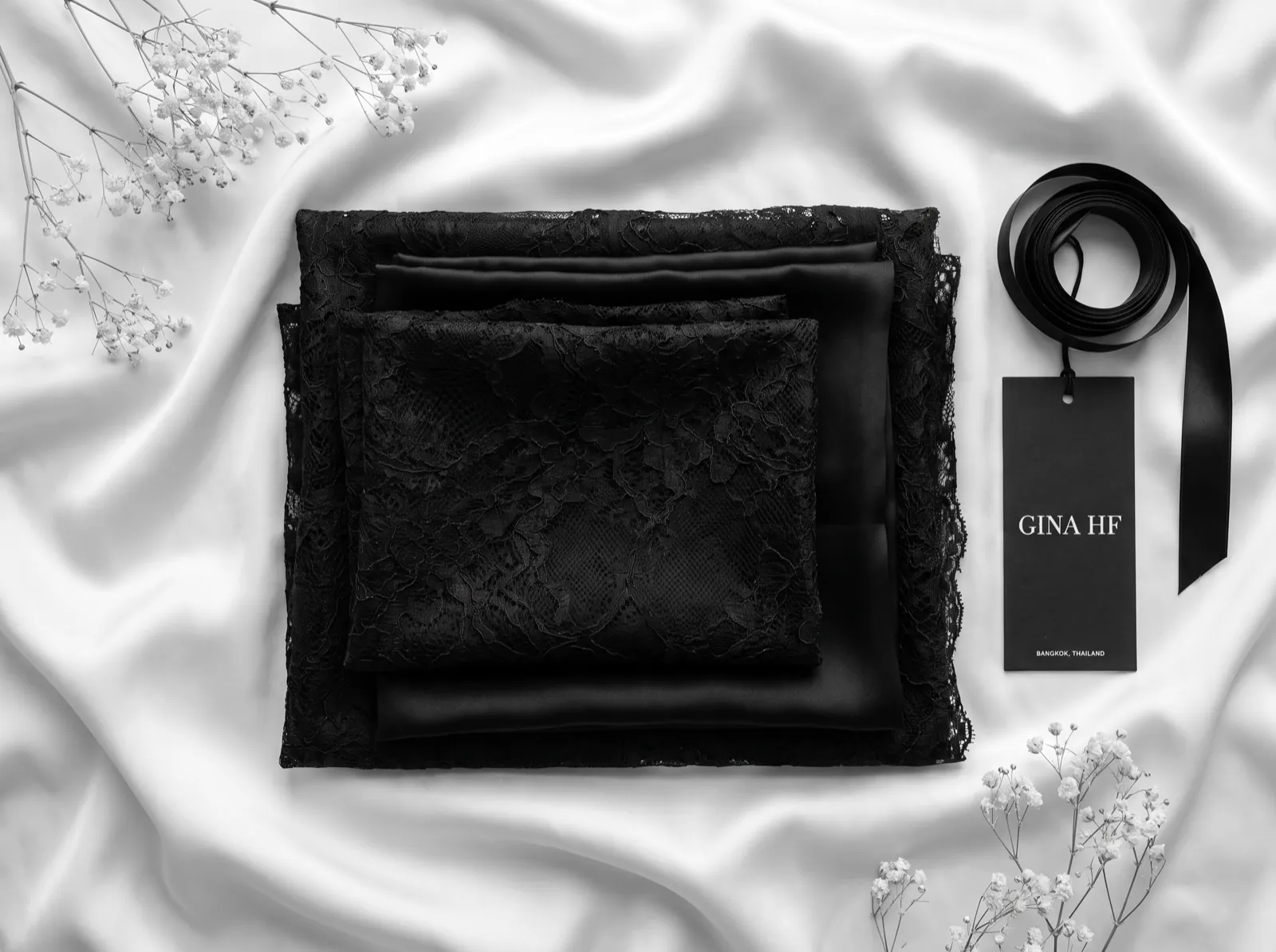
We keep the range narrow on purpose: fewer styles, each one solved properly, in silk crêpe de Chine and Chantilly and the particular meshes that behave over long hours. We would rather a woman own three pieces she reaches for without thinking than a drawer full of compromises. That is the whole proposition of this house, and it begins every morning, alone, in front of a drawer.