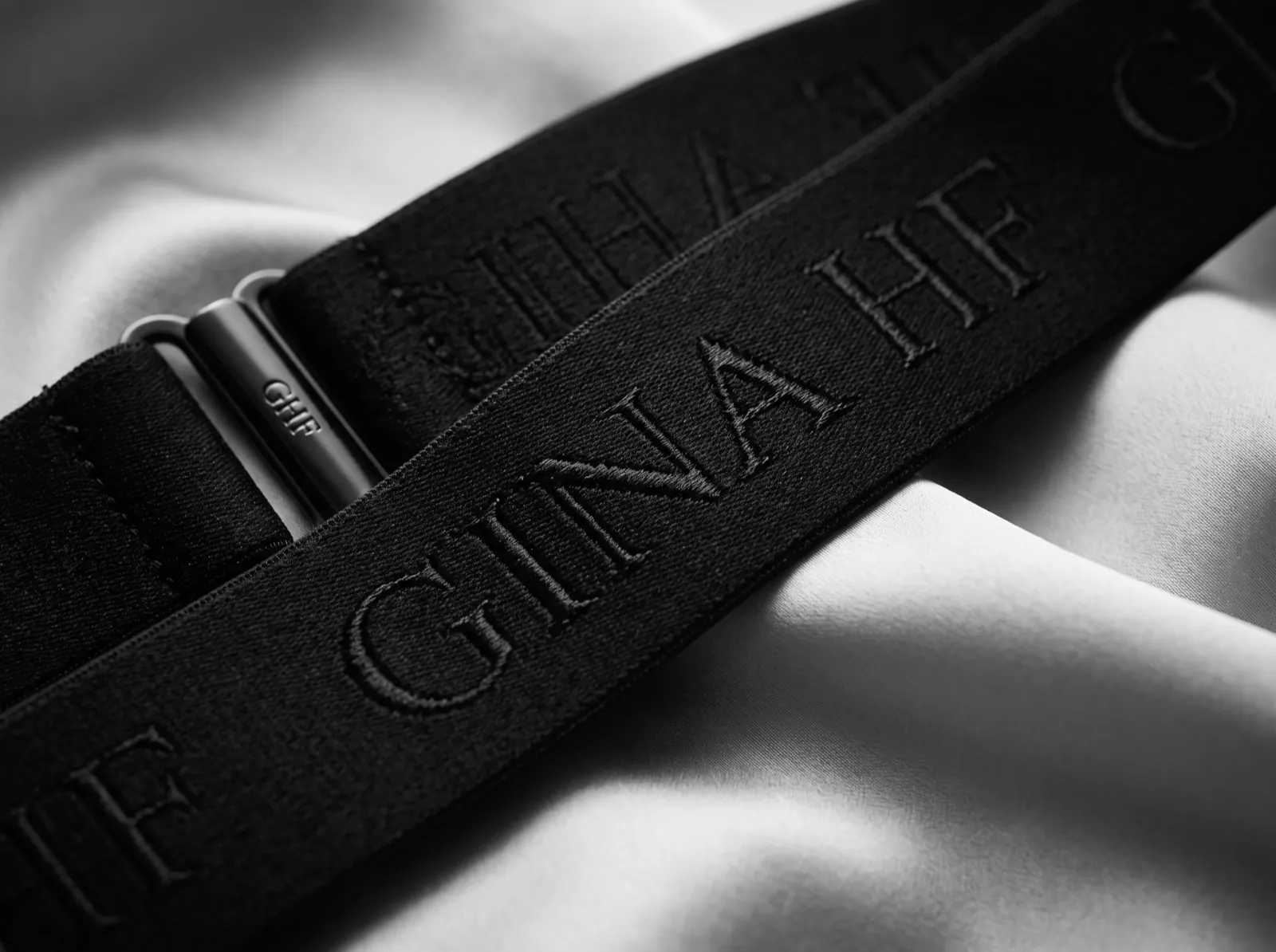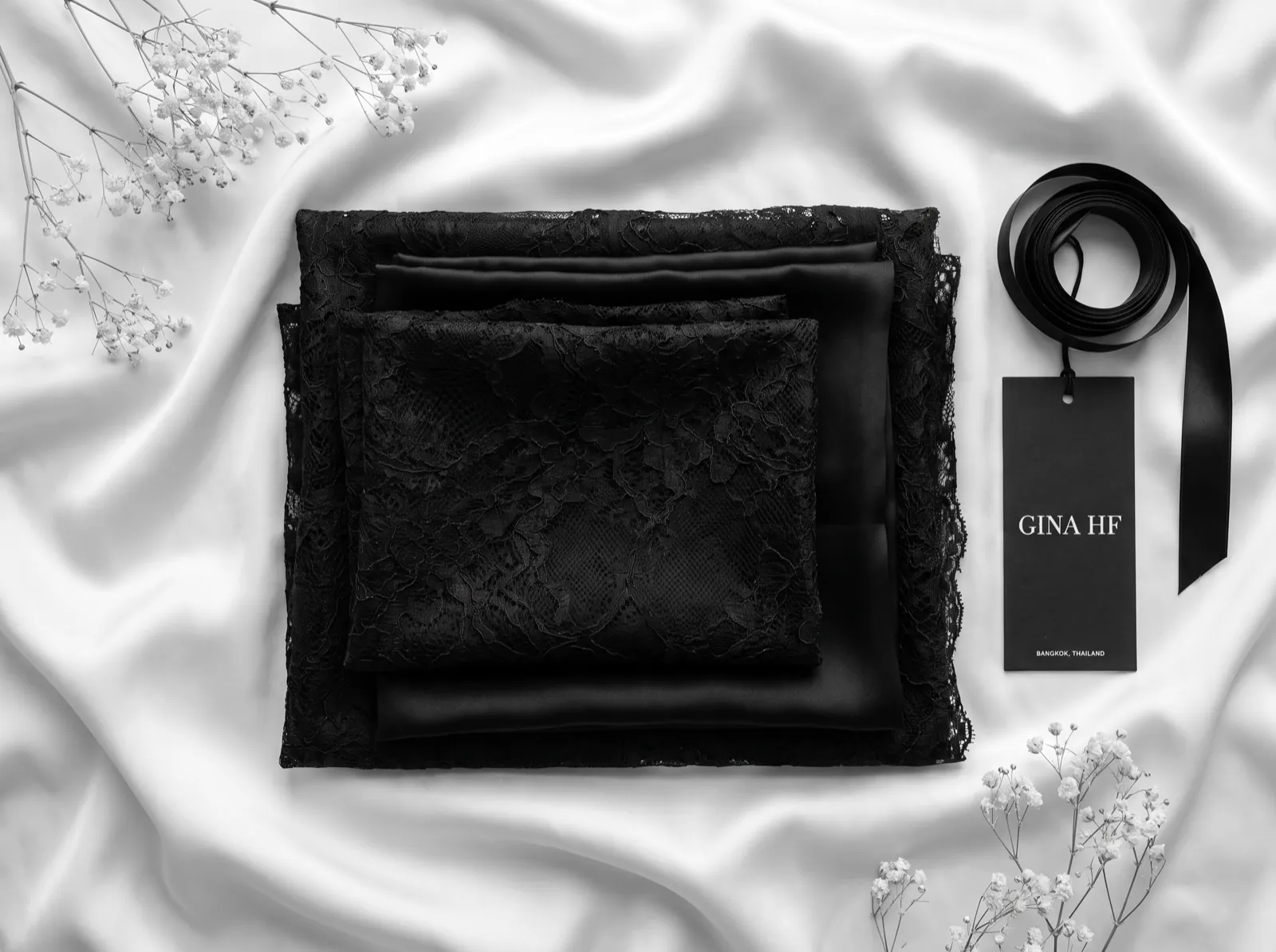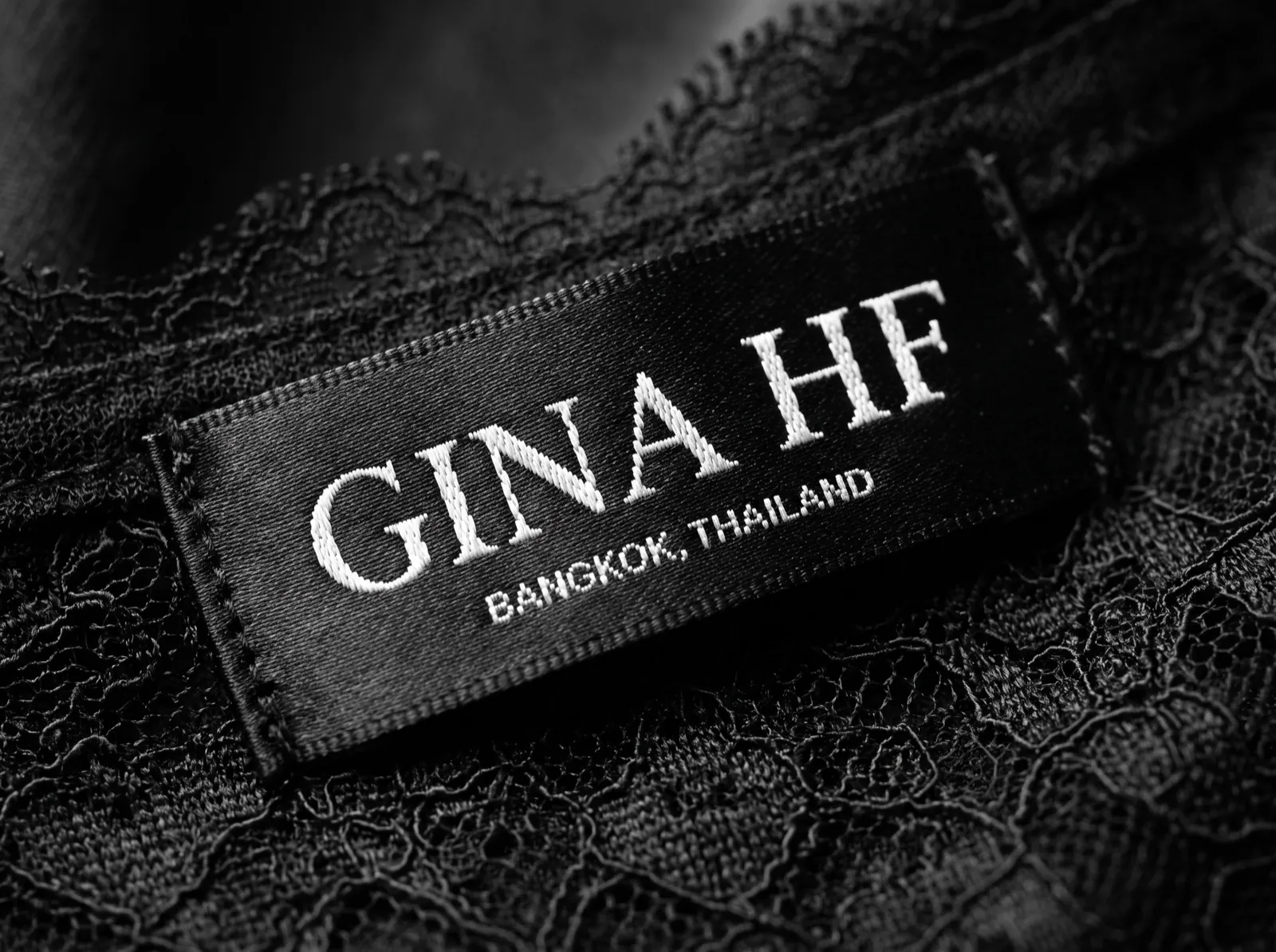
Chantilly against Leavers, the two faces of charmeuse, the picot on an elastic. In a house without colour, the surface is the whole content.
Take a piece out of the drawer and, before you look at it, close your hand around it. You will know almost everything already. Whether the lace has body or falls like water. Whether the silk has been washed enough times to go soft or is still new and slightly cool. Whether the elastic at the edge is a flat tape or has that fine scalloped picot along one side that catches faintly on the pad of your thumb. In a house that has removed colour from the conversation, this is the conversation. The surface is not decoration on top of the design. It is the design.
Two French laces, two different intentions
Almost all fine lingerie lace comes from the same corner of northern France, and almost all of it is one of two things. They are made on different machines, they behave differently in the hand, and knowing which is which changes what you are willing to pay for.
- Chantilly — an extremely fine net ground with the motif outlined in a heavier thread called cordonnet. The ground is so light it disappears against skin; what you see is the drawn outline floating, and what you feel is almost nothing at all. It is the lace to use when you want a shadow rather than a garment, and it is fragile: a fingernail catching the ground will run it.
- Leavers — woven on a nineteenth-century machine that is still the only way to make it, denser and with more thread in the ground, so it has body and holds a shape. Crucially it comes off the loom with a finished scalloped edge — a true selvedge — which means the edge is a woven edge, not a cut one. It can be used raw, with nothing sewn along it, and it will never fray.
That selvedge is the entire tell. A machine-made lace has to be cut from the roll, and a cut lace edge must be bound, or hemmed, or scalloped by a second operation — and whatever is done to it produces a line of stitching that you can feel and, under a fitted dress, often see. A Leavers edge lies flat against the thigh with no stitch at all along it. This is why the same eight centimetres of lace at the leg of a brief can cost four times what it looks like it should. You are not buying pattern. You are buying an edge that does not need anything done to it.
One cloth with two faces
Silk charmeuse is woven with a satin float on one side and a crêpe-set structure on the other, which means every metre of it is two textures. The face is lustrous, cool and slippery; the reverse is matte, drier, with a faint tooth to it. Most houses treat the matte side as a lining and forget about it. It is much more interesting used deliberately.
Turn a strap facing so the matte side shows and you get a band that reads as a different material from the slip it belongs to, without changing the colour, the lot or the supplier. Line a cup with the matte face against the body and the shine stays outward where it is looked at while the drier surface sits against the skin, where it is felt — a small thing that changes how a piece feels in a warm room, because a satin face against damp skin clings and a crêpe-set reverse does not. One cloth, two answers, and the only cost is remembering which way up it went on the cutting table.
The materials that are only felt
Then there are the surfaces that exist entirely for the hand, because nobody will ever see them. Power mesh is the flat, dense, four-way stretch knit used in the wings of a bra and along the sides of a body; it is engineered for recovery, not appearance, and its job is to pull without printing a ridge through whatever is worn over it. A good power mesh is smooth on both faces and slightly cool; a cheap one has a directional grain you can feel with a fingertip and will roll at its cut edge within a season.
Reinforcement tulle sits inside the cup, invisible, a fine stiff net laminated behind the fashion fabric to stop it stretching along the bias and letting the cup collapse. You will never see it and you will absolutely notice its absence — a cup without it goes soft at the top edge by the fourth wash and never comes back. And a flatlock seam, where two edges are butted together and stitched flat rather than folded and overlapped, is the difference between a seam you cannot find under a dress and a seam that draws a line across you in a photograph. It takes roughly four times as long to sew. It is the most expensive thing in a garment that nobody can point to.
The picot on an elastic belongs to the same family. That row of tiny loops along one edge exists partly to look pretty and mostly to soften the transition where the elastic ends and you begin — an edge that stops gradually instead of all at once. Run your thumb along it. That is a finishing decision made by someone who assumed the wearer would be paying attention with her hands.
“The eye can be persuaded. The hand cannot. We finish for the hand and let the eye follow it.”
The atelier
Designing for the hand first
Practically, this inverts how a piece is developed. The first sample is not judged on a stand under a light; it is judged worn, sitting down, for an hour. What we are looking for is friction — a label that scratches at the nape, a wire casing with a hard end, a seam that sits exactly where a waistband will cross it, a lace ground that is beautiful flat and abrasive under pressure. None of these show in a photograph. All of them decide whether a woman reaches for the piece again in three weeks, which is the only measure of a garment that has ever meant anything.
And that is the real argument for treating texture as the subject. Everything else about what you wear underneath is provisional — it can be styled, photographed, complimented, misread. The surface against your skin is the one part of it that is only ever judged by you, alone, at the end of a long day, with nobody in the room to be impressed. Make that part good and the rest takes care of itself.