
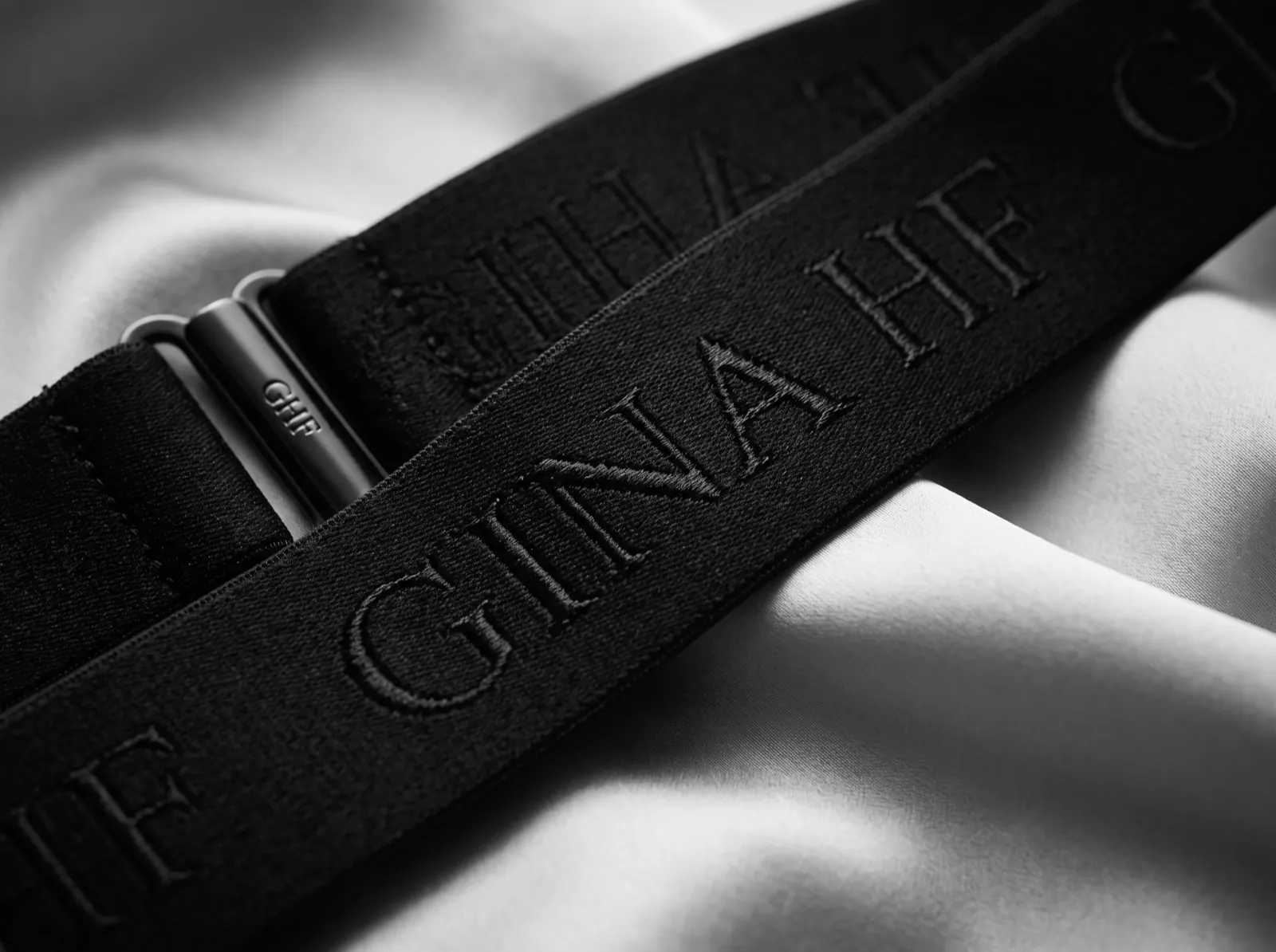
The band carries eighty per cent of the load and is cut fifteen to twenty per cent shorter than the body. Cup grading, strap angle, sister sizing, gore height, wire width — the real numbers behind a good fit.
Grace looks like an accident of the body. It is not. Under every piece that fits well there is a short list of numbers, and they are the same numbers whether the garment costs forty pounds or four hundred. What separates good lingerie from bad is not sentiment or lace. It is whether those numbers were respected, and whether anybody bothered to change them properly as the sizes grew.
The band does eighty per cent of the work
This is the single most useful thing anyone can know about a bra, and almost nobody is told it. The band — the horizontal circle around the ribcage — carries roughly eighty per cent of the load. The straps carry the remaining twenty. Every woman who has tightened her straps to fix a sagging bust has been treating the symptom of a band that was too big, and has been paying for it with grooves in her shoulders.
A band works because it is in tension against the ribcage, and tension requires that it be shorter than what it goes around. So the band is cut fifteen to twenty per cent shorter than the body measurement it is intended for. A 75 band, sitting on a ribcage of about 75 centimetres, is cut and assembled at roughly 60 to 64 centimetres and stretched onto the body. That negative ease is the whole mechanism. Cut it to the actual measurement and it will do nothing at all: it will ride up the back, tip the cups forward, and hand the entire load to two shoulder straps that were never designed for it.
Which fraction of the fifteen to twenty per cent we use depends on the elastic. A firmer, lower-stretch band elastic sits nearer fifteen per cent; a softer one, or a wider band on a larger size, goes nearer twenty. The correct band is level all the way around and does not move when you raise both arms. If it rises at the back, it is too long, and no other adjustment will save the garment.
Grading a cup: volume moves, the apex does not
A cup cannot be scaled like a photograph. Enlarging a whole cup pattern by a percentage produces a shape that is bigger in every direction, including the one that matters least, and the apex — the point of the cup — migrates outward and upward as it goes. On a larger size that apex ends up somewhere no body actually is, and the cup wrinkles because it is holding volume in the wrong place.
Proper cup grading adds volume while holding the apex still. The added depth is distributed into the seams that carry it — most of it into the lower cup, where the weight actually sits, and rather less into the upper, which is a covering rather than a support. The wire length grows on its own schedule, because it follows the root of the breast on the ribcage rather than the volume above it. Three separate rules, moving together. Treat them as one number and the garment fits precisely one size well and everything else approximately.
“Fit is not an opinion. It is arithmetic that has been done, or arithmetic that has been skipped.”
The fitting room, Bangkok
The angle of the strap
A strap should be as close to vertical as the design allows, measured against the horizontal line of the band. The load it carries runs straight down; any deviation from vertical turns part of that load into a sideways pull, which is what drags a strap off a shoulder. The strap that keeps slipping is rarely too loose. It is usually set too far out on the shoulder, so its line is diagonal and gravity is quietly working to move it.
So the back attachment sits close to the centre, near the shoulder blades rather than out towards the arms, and the front is placed so that the strap line falls roughly over the apex of the cup rather than outside it. As the sizes grow, this point moves — a strap placement that is correct at the mother size is too far out three sizes up, which is exactly why gaping and slipping tend to appear at the edges of a poorly graded range. Strap placement is part of the grade, not a fixed constant.
Sister sizing: the volume stays the same
Cup letters are not absolute volumes. They are proportions relative to the band, which means the same letter describes a different amount of cloth on every band size. Understanding this gives you a lever most women never use.
- Go up one band and down one cup letter — 75C to 80B — and the cup volume is unchanged. You have simply loosened the ribcage.
- Go down one band and up one cup letter — 75C to 70D — and again the volume is identical. You have tightened the band while keeping the same bust.
- The rule to remember: a bigger band with the same letter means a bigger cup. A 80C holds more than a 70C, though both say C.
- In practice, most fit complaints are solved by going down a band and up a cup, because a too-loose band is the most common error in ready-to-wear.
Sister sizing is also why we prove a design in three sizes rather than one. A shape that only holds together at its mother size is not a design; the sister relationships are what tell us whether the volume has been distributed correctly across the range.
The gore and the wire
The gore is the small bridge of fabric between the two cups, and its height is a real design decision rather than a stylistic one. It should sit flat against the sternum — tacked, in the fitting-room word — because that contact is what stops the cups from swinging independently and what keeps the wires anchored on the ribcage. A gore that stands away from the body means the wires are too narrow for the root of the breast, and the cups are being held apart by the body itself.
Gore height moves inversely with cup volume: taller for a smaller cup, where a high bridge is comfortable and adds stability, and lower as the cup grows, because a tall gore on a full bust presses against tissue that has moved inward. As for the wire, its width must match the root of the breast where it meets the ribcage — not the visible width of the bust. Too narrow and it sits on breast tissue, which is the sensation most women describe as being stabbed. Too wide and it lands on the arm hollow and lifts away with every movement. Wire width and wire length are separate measurements and are graded separately, because two women with identical volume can have quite different roots.
None of this is romantic, and all of it is the reason a piece feels like nothing at all by the eighth hour. The numbers exist so that you never have to think about them — so that what you notice, at the end of a long day, is only the silk and the quiet, and not the architecture holding it up.